Design
Boutique Hotel Restaurant Design Firm in Miami: Can You Renovate Without Closing?

Cover photo: Marriott Project - Design Lead: Santiago Muñoz
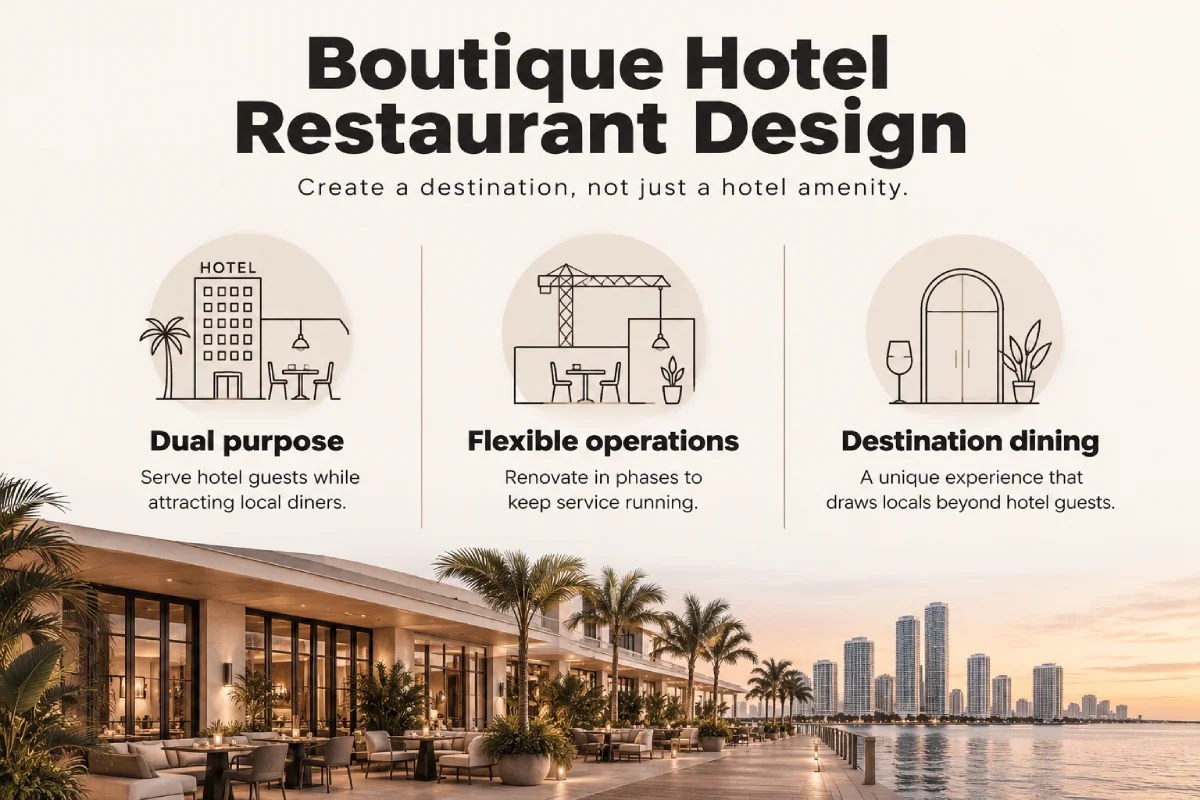
A boutique hotel restaurant works harder than a standalone restaurant ever has to. It serves hotel guests at breakfast, lunch, and dinner, seven days a week, while also needing to function as a destination that attracts local diners who have no other reason to walk into the building. Finding a hotel restaurant design firm for boutique hotels in Miami means finding a team that understands both jobs at once, because a restaurant designed only as a guest amenity rarely becomes a revenue driver on its own.
What Makes Hotel Restaurant Design Different
A standalone restaurant is designed around a single service pattern and a single brand. A boutique hotel restaurant has to solve several problems simultaneously:
- Flow between the lobby, restaurant, and bar areas, so a guest arriving for check-in, a diner arriving for dinner, and a hotel guest heading to the bar all move through the space without friction.
- Flexible seating that works for a quiet breakfast service and a busy dinner service, without feeling either too sparse in the morning or too tight at night.
- A design language that reinforces the hotel's overall brand rather than reading as a separate business awkwardly attached to the lobby.
Independent and boutique hotels feel this challenge more acutely than chain properties, because there is no corporate prototype to fall back on. The restaurant has to be original enough to stand on its own as a local dining destination, while still feeling like a natural extension of the hotel's identity.
The AI Spaces Process for Independent Miami Hotel Properties
Restaurant renovation inside an operating hotel cannot follow the same playbook as a standalone restaurant closing for a few weeks of construction. AI Spaces builds these projects around a phased renovation sequence specifically because the restaurant usually cannot close entirely: it is a guest amenity the hotel is contractually and operationally expected to provide.
That typically means sectioning the restaurant into zones, renovating one zone while service continues in the others, and shifting seating configurations week to week as each section comes back online. Kitchen work, when required, is scheduled around service windows rather than shutting the kitchen down entirely; often meaning early-morning or overnight work for the noisiest or most disruptive phases.
Function as Both a Guest Amenity and a Destination
The design choices that make a hotel restaurant succeed as a local destination are often the same ones that make it work better for guests: a bar area with its own street-level presence and entrance appeal, lighting that shifts convincingly from a casual breakfast mood to an evening dining mood, and a layout that lets the restaurant feel busy and alive even when hotel occupancy is running low. A restaurant that only works when the hotel is full is a liability. One designed to draw local traffic on its own terms is a revenue stream independent of occupancy.
Materials and Brand Continuity
The hardest technical problem in boutique hotel restaurant design is rarely the layout. It is making the restaurant's material palette feel connected to the hotel's overall identity without simply repeating the lobby's finishes verbatim; which reads as uninspired and undercuts the restaurant's ability to feel like its own destination. AI Spaces approaches this by identifying two or three signature materials or design gestures from the hotel's brand: a specific wood tone, a lighting fixture family, a color used sparingly; and reinterpreting them within the restaurant's own design language rather than duplicating them outright.
This matters most for independent Miami properties competing against chain hotels with far larger design budgets. A boutique property cannot out-spend a flagged hotel brand on square footage or amenities, but it can out-design them on originality; and the restaurant is usually the single space in the building with the most freedom to make that case to a guest or a local diner deciding where to spend their evening.
Frequently Asked Questions
- Can you renovate a hotel restaurant without closing it completely?
- In most cases, yes. AI Spaces phases the renovation by zone so at least part of the restaurant remains open throughout construction, since a full closure is rarely acceptable for a hotel's guest amenity.
- How much does it cost to renovate a hotel restaurant in Miami?
- Costs vary widely by square footage, kitchen scope, and finish level, but a phased boutique hotel restaurant renovation typically runs from the low hundreds of thousands into the low millions depending on whether kitchen equipment is being replaced.
- How do you design a hotel restaurant that works for both guests and local diners?
- By building in flexible seating and lighting that shift between breakfast and dinner moods, and by giving the restaurant its own street-level identity and entrance appeal so it reads as a destination, not just a hotel amenity.
- Who designs restaurants specifically for boutique or independent hotels, not chains?
- AI Spaces works specifically with independent and boutique hotel properties in Miami, where there is no corporate restaurant prototype to fall back on and the design has to originate from that property's own brand.
- How long does a hotel restaurant renovation typically take?
- A phased renovation that keeps the restaurant partially operational typically runs longer than a full closure project; often 12 to 20 weeks depending on kitchen scope, precisely because work is sequenced around continued service.
- Can the hotel restaurant stay open during breakfast or dinner service while under construction?
- Yes, this is the specific goal of phasing the renovation by zone. The most disruptive work, particularly kitchen-related, is typically scheduled overnight or in off-service windows to protect breakfast and dinner service.
See completed hotel restaurant transformations before committing to a project.
View the portfolio and schedule a walkthrough at AI Spaces