Architecture
How to Design High-Pressure Offices That Actually Support Human Performance

AI SPACES | LEGAL BRANDING | APRIL 2026
The legal office where the lighting never changes between eight in the morning and ten at night. The trading floor where ambient noise levels prevent any thought that requires more than thirty seconds of sustained attention. The corporate headquarters where glass walls eliminate every moment of visual privacy and the open plan ensures that stress is not just experienced individually but performed publicly. These environments do not make people perform better under pressure. They accelerate burnout, impair judgment, and drive the talent they were built to house out the door.
Wellness-centered design for high-pressure environments is the discipline of creating spaces that sustain peak performance over time, not by removing challenge, but by ensuring that the physical environment supports the neurological, physiological, and psychological conditions under which human beings actually do their best work. At AI Spaces, we design these environments for financial institutions, legal firms, corporate headquarters, and fast-growing companies across Miami and Latin America. Here is what that requires.
The Business Case: Wellness as a Performance Investment
Before addressing the design toolkit, the framing matters. Wellness-centered workplace design is not a benefits program or a cultural statement; it is a performance investment with a measurable return. Organizations that treat it as the former tend to implement it superficially and inconsistently. Organizations that treat it as the latter apply it with the same rigor they bring to any capital decision.
The evidence is now sufficiently robust to be treated as operational data rather than academic research. Natural light in workspaces has been shown in peer-reviewed studies to improve sleep quality, reduce absenteeism, and increase cognitive performance among office workers. Thermal comfort within a defined range, 70 to 77 degrees Fahrenheit, has a statistically significant effect on error rates in precision work. Acoustic management that reduces ambient noise below 50 decibels has measurable effects on reading comprehension, working memory, and decision quality.
Performance data: Organizations that have invested in WELL-certified workplace environments report average reductions in absenteeism of 15 to 20 percent and measurable improvements in self-reported cognitive performance, numbers that translate directly to productivity and retention outcomes on the P&L
For organizations whose competitive advantage rests on the quality of human judgment, law firms, financial institutions, strategic consulting practices, technology companies, the marginal improvement in cognitive performance that a well-designed environment delivers is not a minor benefit. It is a structural advantage that compounds every working day.

Natural Light: The Highest-Return Wellness Investment
Of all the architectural elements that affect human performance in workplace environments, natural light has the most consistent and well-documented effect. The circadian system, the internal biological clock that regulates alertness, cognitive performance, mood, and sleep, is fundamentally driven by light exposure. Office workers who receive insufficient natural light during the working day experience disrupted circadian rhythms that impair performance during working hours and sleep quality afterward. The compounding effect of chronic circadian disruption in high-demand environments is significant and measurable.
Designing for meaningful natural light access in a high-pressure office is a spatial problem before it is a technical one. It requires decisions about floor plate depth, partition placement, and the distribution of enclosed spaces that must be made at the earliest stages of the design process, not added as a finish detail at the end.
The natural light strategies that have the most consistent impact on occupant performance:
- Floor plate depth management, enclosed offices and meeting rooms placed at the building core, open and semi-open working areas positioned at the perimeter where daylight penetrates deepest
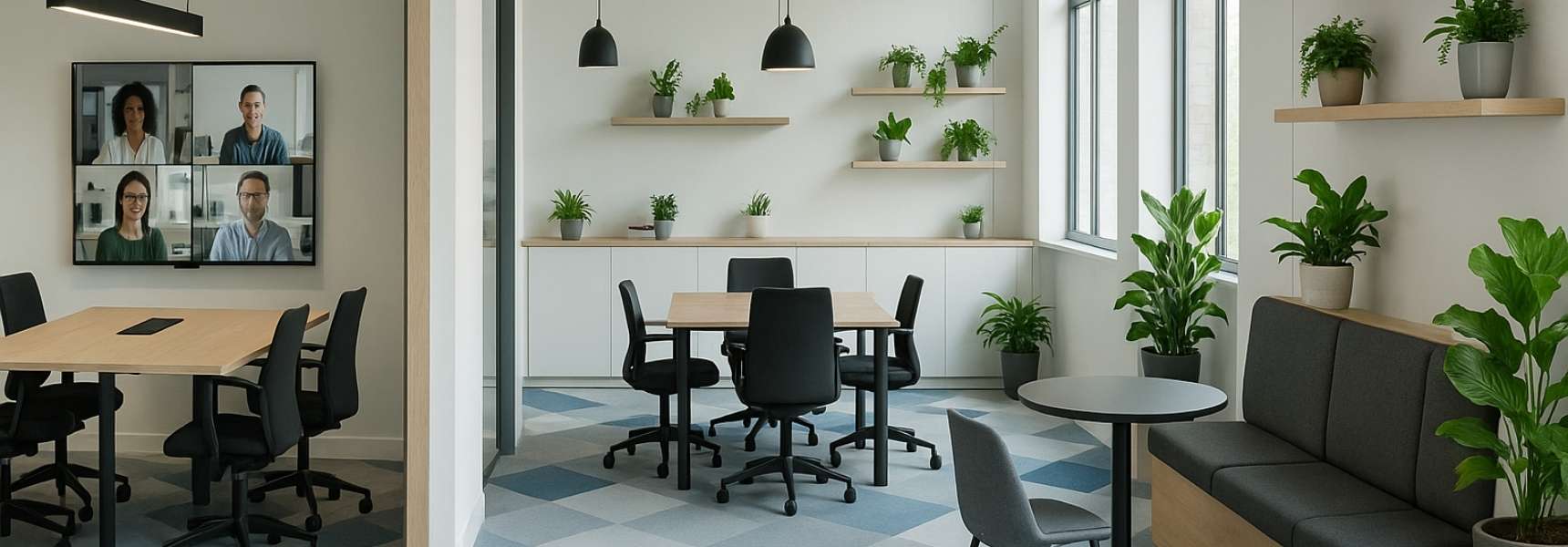
- Interior glazing, glass partitions on enclosed offices and meeting rooms that allow daylight to pass through the perimeter zone into the interior without sacrificing acoustic separation
- Clerestory windows and skylights, where the architecture permits, high-level glazing that introduces daylight into deep floor plates without the glare problems of low-level windows
- Circadian lighting systems, tunable LED systems that shift color temperature and intensity across the working day, mimicking the natural progression from cool morning light through warm afternoon light, maintaining circadian alignment regardless of cloud cover or seasonal variation
Acoustic Control: Protecting the Conditions for Thought
Cognitive work, analysis, writing, judgment, strategic thinking, requires sustained periods of focused attention. Sustained attention is fragile. It is disrupted by unpredictable sound events at a neurological level: the brain's threat-detection system treats unexpected noise as a potential danger signal, involuntarily redirecting attention away from the task at hand toward the source of the sound. In a noisy open-plan environment, this interruption cycle repeats dozens to hundreds of times per hour.
The cumulative effect on high-pressure workers is not merely annoyance. It is a documented increase in cognitive load, the mental effort required to maintain focus in spite of interruption, that consumes precisely the cognitive resources that high-pressure work demands. Employees in noisy environments do not just find it harder to concentrate. They make more errors, exercise less careful judgment, and experience higher levels of physiological stress markers than equivalent employees in acoustically managed environments.
The acoustic design interventions that have the most significant impact on cognitive performance in high-pressure environments:
- Background sound masking systems, electronically generated broadband sound at a calibrated level that raises the ambient noise floor just enough to make speech from adjacent workstations unintelligible, without adding perceived noise to the environment
- Absorption-diffusion-isolation as a layered strategy, absorptive surfaces, ceiling panels, wall treatment, upholstered furniture, reduce reverberation; diffusive surfaces, textured walls, irregular ceiling geometry, scatter sound energy; isolation, full-height partitions, acoustic seals on doors, prevents transmission between zones
- Spatial separation of loud and quiet activities, video call infrastructure, collaborative working areas, and social zones positioned away from focus zones, with sufficient distance and acoustic treatment between them to prevent cross-contamination
- Designated silence norms, architectural design that makes the behavioral expectation of each zone legible, a library-style focus area communicates its purpose through materiality and scale in ways that a sign never could
Spatial Transitions: Designing the Nervous System of the Office
One of the least discussed and most impactful dimensions of wellness design in high-pressure environments is spatial transition, the deliberate design of the moments between intensive work activities. In a well-designed high-pressure office, the movement from a client meeting to a working session, from a trading position to a team discussion, from two hours of document review to a coffee break, is not merely physical relocation. It is a designed decompression sequence.
The research on cognitive recovery, the process by which the prefrontal cortex restores executive function after sustained demand, consistently shows that brief, genuine disengagement from work tasks accelerates recovery more effectively than continued effort at lower intensity. The design implication is significant: an office that provides no environmental variety, no spaces that invite genuine disengagement, no moments of sensory relief from the dominant aesthetic of the workplace, is an office that is structurally impairing the recovery capacity of its people.
The spatial transitions and recovery environments that the highest-performing high-pressure offices incorporate:
- Threshold moments between zones, a material change, a shift in ceiling height, a change in lighting temperature that signals to the nervous system that a different mode of engagement is appropriate here
- Refuge spaces, small, enclosed, softly lit areas with no screens, no standing desks, and no acoustic connection to the working environment; spaces designed for five to fifteen minutes of genuine disengagement
- View corridors, deliberate sight lines to external views, green space, or water features that provide the involuntary attention restoration that cognitive scientists associate with exposure to natural environments
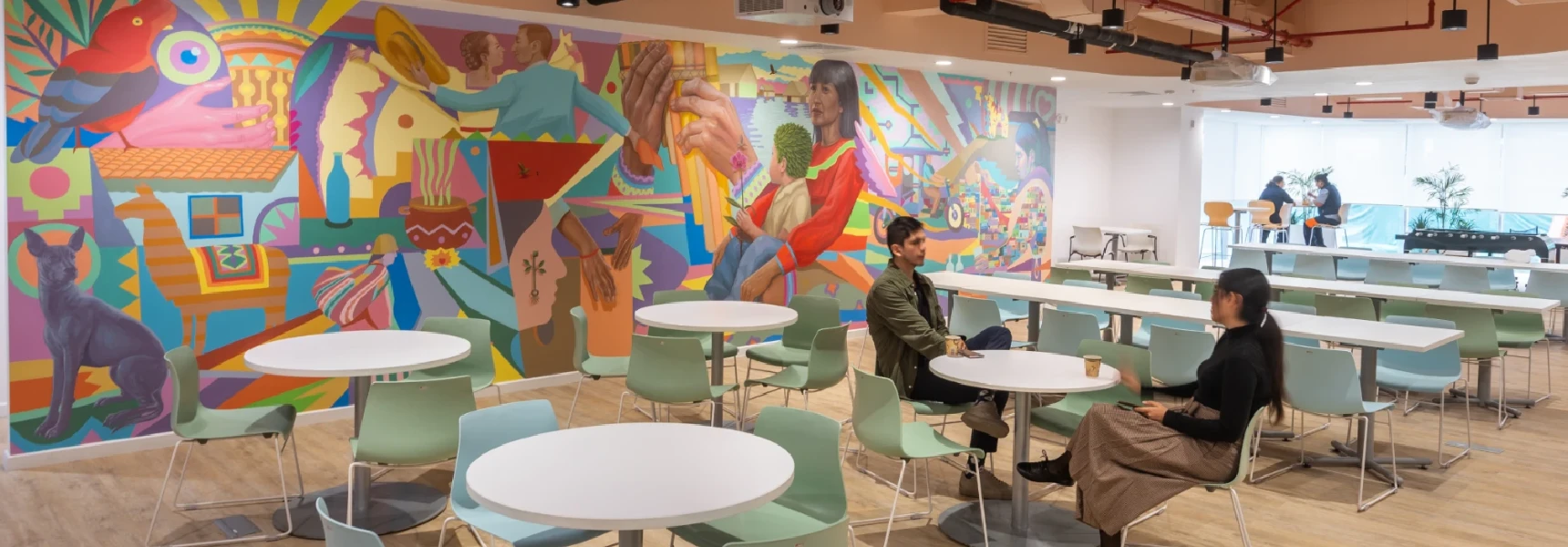
- Transition rituals built into the architecture, a coffee point positioned between the intensive working zone and the collaborative zone that creates a natural pause in the movement between activities
Biophilic Design: Nature as Performance Infrastructure
Biophilic design, the incorporation of natural elements, materials, and patterns into built environments, has moved from a wellness aspiration to a performance standard in the design of high-pressure workplaces. The mechanism is well-understood: human beings have evolved over hundreds of thousands of years in natural environments, and the nervous system responds to natural stimuli with measurable reductions in physiological stress markers, including cortisol levels, heart rate variability, and skin conductance.
In a high-pressure corporate environment, where physiological stress is a constant feature of the working day, biophilic design functions as a continuous low-level stress regulation system. Its effects are not dramatic or immediate; they accumulate over hours and days, moderating the stress response in ways that preserve cognitive capacity and reduce the physical health effects of sustained pressure.
The biophilic elements with the most consistent performance impact in workplace settings:
- Living plant walls and interior planting, not as decoration but as genuine biomass with measurable effects on air quality, humidity, and psychological restoration; the scale should be sufficient to register as a natural environment, not a gesture toward one
- Natural material surfaces, wood, stone, cork, leather, and textile surfaces that engage the tactile sense and provide the material richness that synthetic surfaces cannot; the effect is measurable in reported comfort and observed dwell time
- Water features, even modest, architecturally integrated water features introduce the sound of moving water, which has consistent relaxation effects and serves as a natural acoustic mask in transition spaces
- Exterior connection, terraces, balconies, or generously glazed facades that allow employees to experience weather, light change, and the movement of the external world without leaving the building
- Organic forms in geometry, furniture, partitions, and ceiling elements with curves, irregularity, and the soft geometries of natural forms rather than the relentless right angles of conventional office design
Thermal Comfort and Air Quality: The Invisible Performance Variables
Two dimensions of the physical environment that are almost never discussed in workplace design conversations, and that have some of the most significant and best-documented effects on cognitive performance, are thermal comfort and indoor air quality. Their invisibility in the design conversation is precisely the problem, because they are not aesthetic concerns, they are addressed by mechanical engineers operating to minimum code compliance rather than by designers optimizing for human performance.
The performance implications of getting these wrong are not minor. Research on thermal comfort consistently shows that cognitive performance, measured by error rates, processing speed, and decision quality, peaks in a narrow temperature band and declines measurably outside it. At 77 degrees Fahrenheit, performance on complex cognitive tasks begins to drop. At 86 degrees, the decline is significant. Similar performance curves apply to CO2 concentration, as indoor CO2 rises above 1000 ppm, a level easily reached in a poorly ventilated meeting room with six people in it, cognitive performance on tasks requiring sustained attention and decision-making declines measurably.
Designing for thermal and air quality performance in a high-pressure office:
- Individual thermal control, zone-level or desk-level temperature control that allows individuals to adjust their immediate environment within a defined range, eliminating the productivity loss caused by one-size-fits-all HVAC settings
- Increased fresh air delivery above minimum code requirements, specifically in meeting rooms and high-occupancy spaces where CO2 accumulates fastest
- Air quality monitoring and display, real-time CO2 and particulate monitors in meeting rooms with visible displays that normalize awareness of air quality and encourage ventilation behavior
- Operable windows where the building envelope permits, the ability to introduce genuine outside air remains the most effective and most satisfying ventilation strategy available
The Retention Argument: Why This Is a Talent Decision
For organizations competing for high-performance talent in demanding professional fields, the physical work environment is increasingly a selection criterion, on both sides of the hiring relationship. Candidates who have choices evaluate the workplace environment as a signal of how the organization treats its people. Employees who develop stress-related health issues, chronic sleep disruption, or burnout that they associate with their physical work environment leave, and they tell colleagues why.
The retention economics are not subtle. In professional services firms, the fully-loaded cost of replacing a senior associate or manager, recruiting, onboarding, the lost productivity of the transition period, and the institutional knowledge that walks out with the departing employee, typically ranges from 50 to 200 percent of annual salary. A workplace environment that meaningfully reduces voluntary turnover among high performers pays for its wellness investment in retained talent within the first twelve to eighteen months of occupation.
This is the business case that resonates most directly with the leadership of high-pressure organizations: not the WELL certification, not the biophilic design language, but the concrete financial return on retaining the people who are most expensive to replace and most critical to the organization's performance.
Performance Is the Product of the Environment
High-pressure work is not going away. The competitive intensity of the industries where performance matters most, law, finance, technology, strategic services, is increasing, not decreasing. The organizations that will sustain peak performance across their teams over the next decade are not the ones that simply demand more from their people. They are the ones that create the physical conditions in which their people can deliver more, consistently, sustainably, and without the accelerating burnout that is currently the primary risk to human capital in high-demand professional environments.
A wellness-centered office in a high-pressure context is not a soft intervention. It is a hard-edged investment in the performance infrastructure of the organization, as consequential as the technology stack, the compensation structure, or the management system. Treating it as anything less is leaving performance on the table.
At AI Spaces, we design high-pressure corporate environments that sustain human performance over time. Not by removing the pressure, that is not our brief and it is not what our clients need. By ensuring that the space supports the people inside it with the same precision and intelligence that those people bring to their work every day.
Want a wellness audit of your current office environment? Book a free 30-minute session with AI Spaces- aispaces.ai
AI Spaces LLC | aispaces.ai | Interior Architecture & Design for Corporations