Design
Why Law Firms Choose AI Spaces for Office Design: Trusted Experts in Legal Workspaces

Law firm office design is not a subset of commercial design. It is a discipline of its own, one that demands an understanding of confidentiality requirements, partner-associate spatial hierarchies, client trust psychology, and the daily operational rhythms of legal practice.
Generic design firms can produce beautiful offices. But law firms need something more specific: a design partner that understands how they actually work.
That is why leading law firms choose AI Spaces.
What Makes Law Firm Office Design Fundamentally Different?
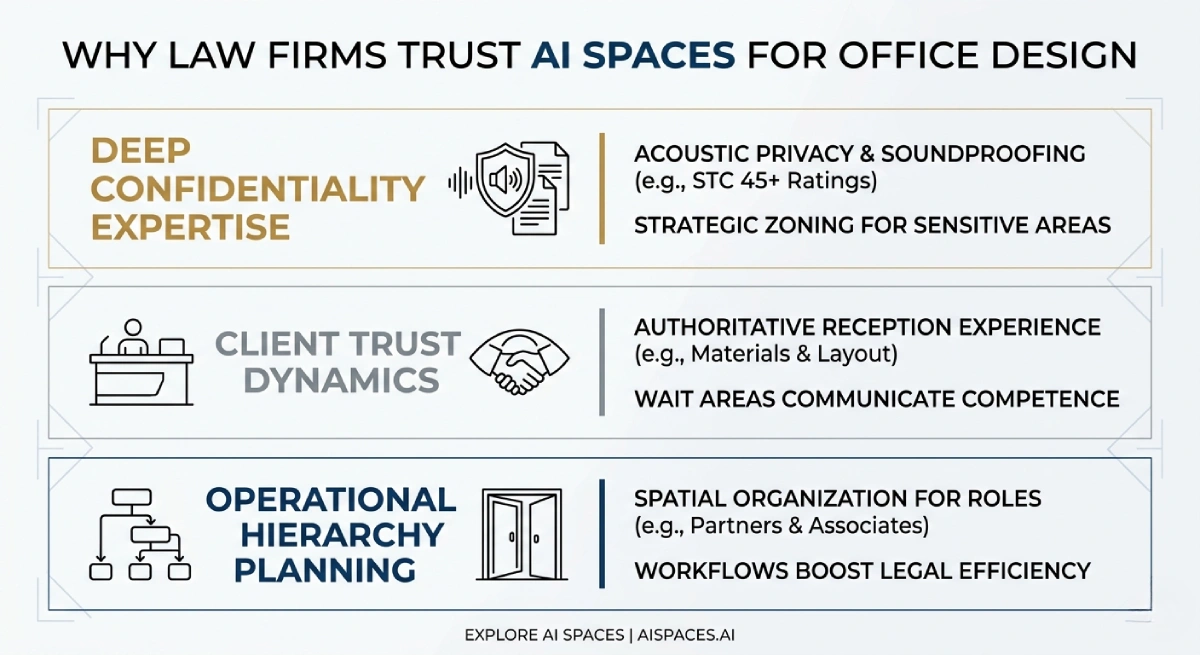
Law firm office design refers to the specialized planning and design of legal workspaces that balance confidentiality, client experience, operational hierarchy, and brand authority, requirements that are distinct from standard corporate office environments.
Before a single design decision is made, a law firm must answer questions that never appear in a generic office brief:
- Where do clients wait, and what do they see while waiting?
- How are partner offices positioned relative to associate and paralegal areas?
- Where are confidential conversations physically protected?
- How does the reception experience communicate authority, stability, and trust?
These questions require sector knowledge that cannot be improvised. They require experience.
Understanding the Legal Sector: What AI Spaces Brings to Every Project
1. Deep Familiarity with Confidentiality Requirements
In legal environments, spatial separation is a functional requirement, not an aesthetic preference.
Client meetings cannot be overheard. Document review areas require visual privacy. Partners need the ability to have sensitive conversations without navigating an open floor plan.
AI Spaces designs with this in mind from the outset, incorporating acoustic planning, strategic door placement, glass specifications with appropriate opacity levels, and circulation paths that separate client-facing and operational areas without creating labyrinthine layouts.
- Acoustic wall ratings (STC 45+ for sensitive meeting rooms)
- Circulation zoning that separates public, semi-private, and private areas
- Document handling areas positioned away from high-traffic zones
- Reception sightlines designed to communicate presence without exposing internal operations
2. Client Trust Dynamics and the Reception Experience
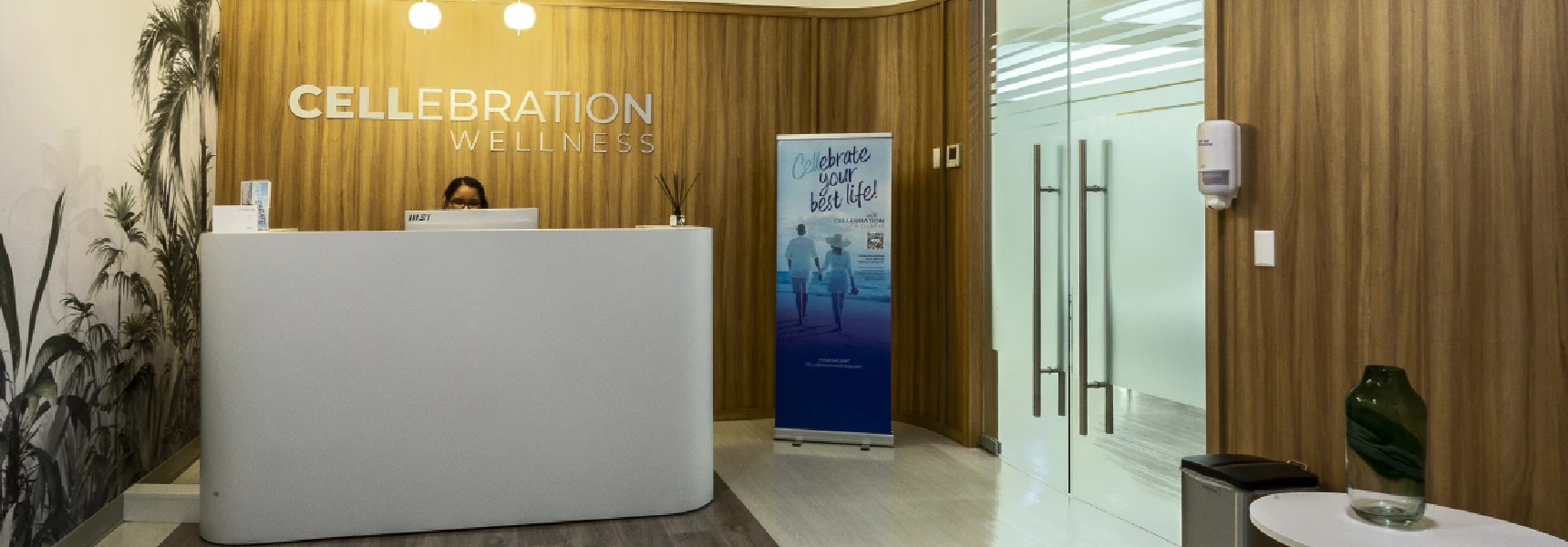
In a law firm, first impressions carry legal weight. Clients arriving for dispute resolution, transactions, or advisory matters are already under stress. The reception experience is the first moment the firm has to communicate: you are in the right hands.
This requires:
- A reception area designed for presence, not just wayfinding. Ceiling height, materials, and the quality of the welcome desk communicate institutional authority before a single word is spoken.
- Controlled visual narrative. What a client sees from reception, whether it's bookshelves, artwork, or a view into a meeting room, should be intentional. Clutter, visible workstations, or casual communal areas undermine perceived professionalism.
- Waiting area calibration. Seating quality, privacy level, and proximity to partner offices all signal how seriously the firm takes the client's time and matter.
AI Spaces designs reception and waiting areas with these dynamics explicitly in mind, not as aesthetic choices, but as trust-building instruments.
3. Spatial Hierarchy Between Partners, Associates, and Clients
How a law firm is perceived internally is often just as important as how it is perceived externally. The physical organization of partner offices, associate workstations, conference suites, and support areas communicates organizational structure, and must do so clearly.
- Partner offices require larger footprints, premium finishes, and positioning that reflects seniority
- Associate areas need density-efficient layouts that support focus work while enabling team communication
- Shared resources (printing, document storage, research) must be accessible without disrupting either tier
Poorly planned spatial hierarchy creates friction: senior partners feeling their status isn't reflected, associates feeling surveilled, and clients confused about where to go. AI Spaces eliminates this friction through deliberate spatial sequencing.
How Design Impacts Client Trust and Operational Efficiency
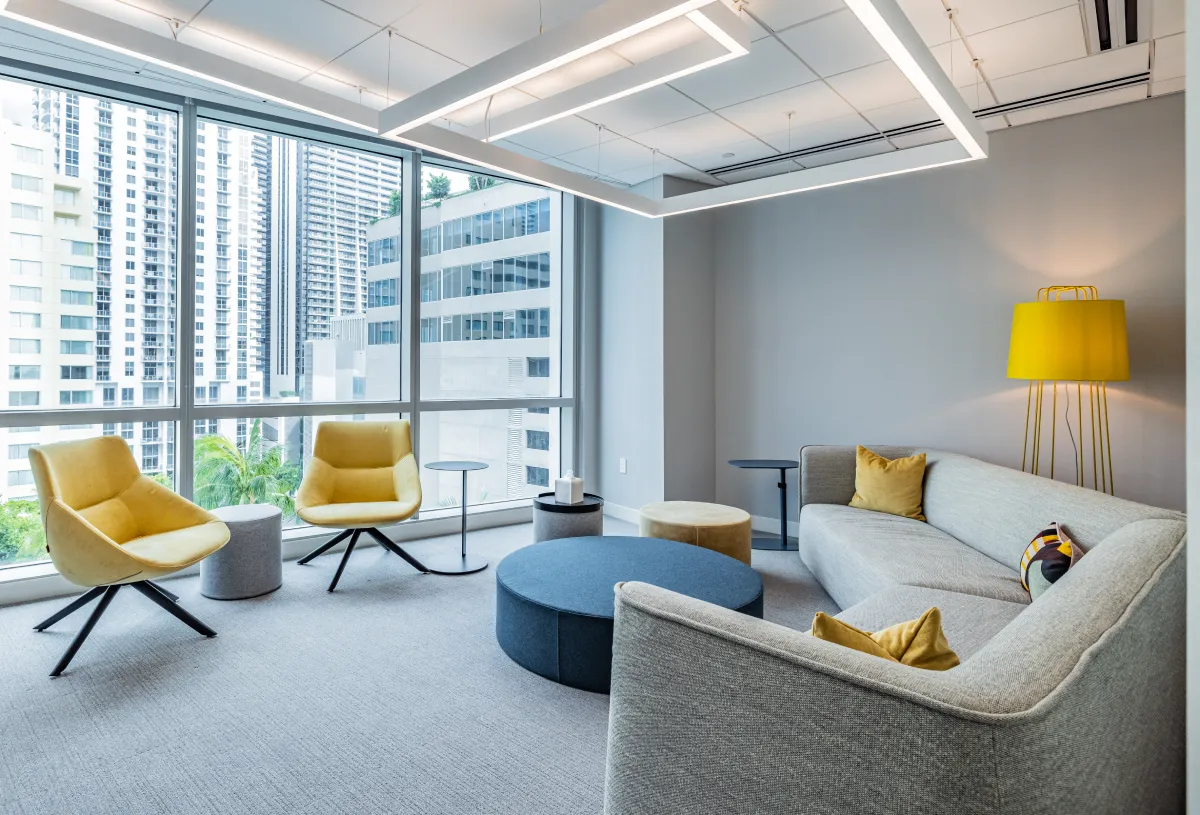
Key considerations in law firm office interior design ultimately come down to two outcomes: client trust and operational efficiency. These are not competing goals, they are complementary.
On the client side: A well-designed office reduces client anxiety, reinforces confidence in the firm's competence, and creates memorable positive associations. In competitive legal markets, this is a differentiating factor in client retention.
On the operational side: Strategic space planning reduces time wasted on avoidable movement, creates natural workflow adjacencies, and supports the technology infrastructure that modern legal practice requires: document management systems, video conferencing for remote depositions, secure server rooms.
AI Spaces approaches both dimensions simultaneously, because in a law firm, they cannot be separated.
The AI Spaces Difference: Strategic Planning Meets Legal Intelligence
What distinguishes AI Spaces from generalist design firms isn't just aesthetic capability; it's the depth of sector understanding brought to every project brief.
Working with professional service firms and legal environments means knowing:
- How different practice areas (litigation vs. transactional vs. advisory) have different spatial needs
- How firm culture (traditional vs. progressive) should influence material palettes and layout openness
- How technology integration (e-discovery suites, virtual hearing rooms) needs to be planned into the infrastructure from day one
- How growth and lateral hiring plans should influence modularity of the design
The result is offices that don't just look impressive; they function as precision instruments for legal practice.
Frequently Asked Questions
- Why do law firms choose specialized office design firms over generalist agencies?
- Because law firm environments have unique requirements, confidentiality, spatial hierarchy, client trust psychology, that generalist designers are not trained to address. A specialist brings sector knowledge that reduces design iterations, avoids compliance missteps, and produces spaces that genuinely support legal operations.
- What are the key considerations in law firm office interior design?
- The most important considerations are: acoustic privacy for confidential conversations, spatial hierarchy reflecting partner and associate roles, a reception experience that communicates trust and authority, and strategic circulation that separates client-facing from operational zones.
- How does law firm office design impact client trust?
- The physical environment communicates competence before the first meeting begins. Reception quality, material choices, spatial clarity, and acoustic comfort all influence how clients perceive the firm's seriousness and institutional authority, directly affecting client retention and referral behavior.
- How does office design improve operational efficiency in law firms?
- By creating strategic workflow adjacencies (placing practice groups near relevant shared resources), designing acoustic zones that reduce interruption, and integrating the technology infrastructure required for modern legal work into the layout from the outset.
- What does AI Spaces understand about the legal sector that other firms may not?
- AI Spaces brings direct experience working with professional service and legal environments, giving the team fluency in confidentiality requirements, hierarchy dynamics, client perception management, and the operational realities of how law firms run day-to-day.