Design
Small Conference Room Design: Layouts, Acoustics, and AV Solutions That Work in Corporate Offices

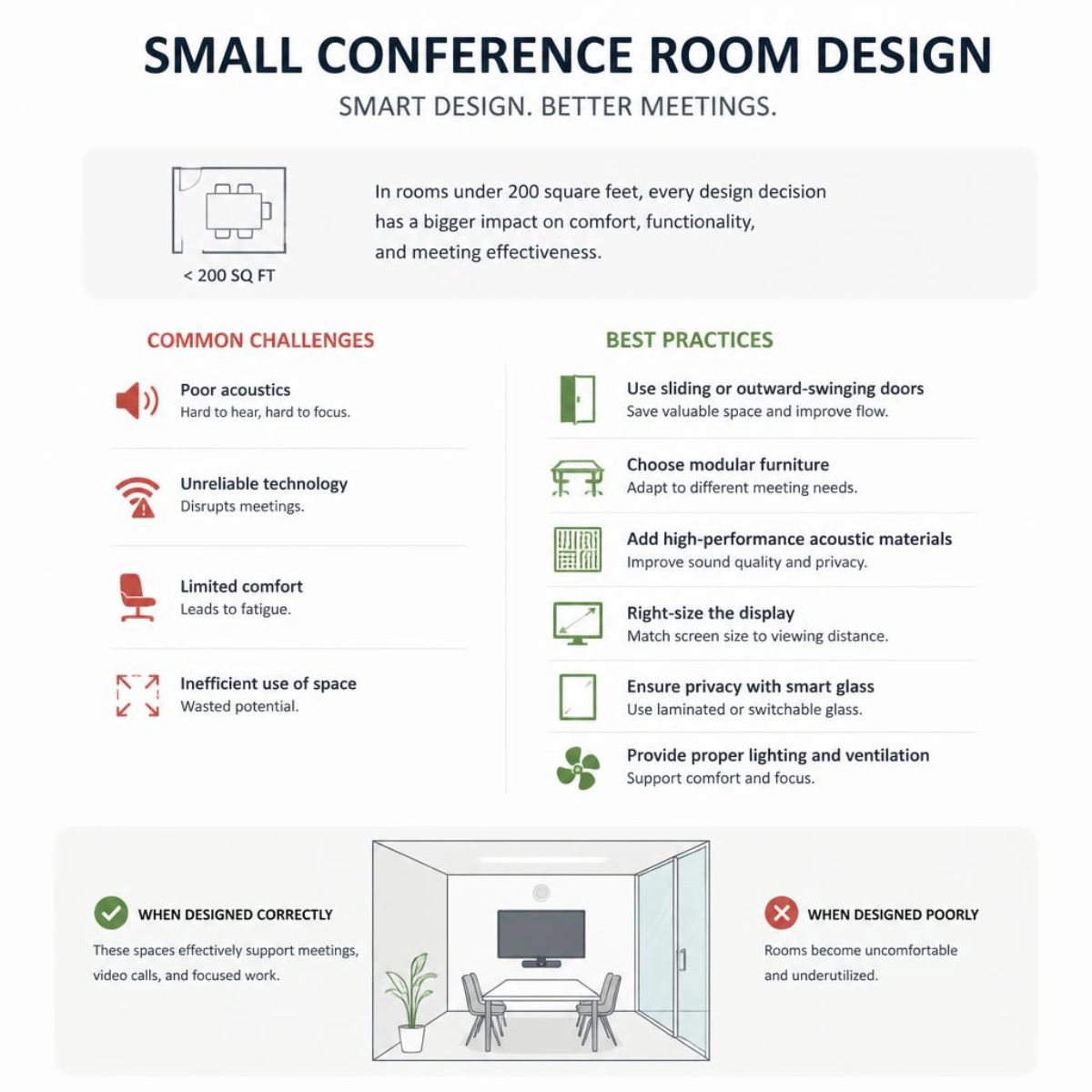
Small conference room design is the process of planning, specifying, and building meeting spaces under 200 sq ft that reliably support focused meetings, video calls, and collaborative work in a corporate office environment. A small conference room that seats four people is theoretically simple. In practice, it is the most frequently misdesigned space in U.S. corporate offices , too hot, acoustically poor, with AV that doesn't work reliably and furniture that seats three instead of four because the door takes a corner.
This guide is for facilities managers, office operations directors, and corporate real estate managers. It covers optimal layouts for rooms under 200 sq ft, acoustic treatment options, AV and technology integration, modular furniture systems, and privacy glass specifications, with the specificity required to actually produce a room that works.
What Is Small Conference Room Design?
Small conference room design is the specialized planning and specification of corporate meeting rooms under 200 sq ft, addressing the compressed occupancy density, competing use cases, and heightened sensitivity to specification errors that characterize rooms of this scale. AI Spaces designs small conference rooms for corporate clients across 49 U.S. states, from standalone huddle rooms to multi-room conference suites.
Why Small Conference Rooms Underperform: The Core Problems
- Occupancy density: A 120 sq ft room with four occupants operates at 30 sq ft per person, where every design error is magnified.
- Competing functions: Small rooms must support structured meetings, video calls, and solo focused work. Design choices that optimize for one mode often compromise another.
- Under-specified infrastructure: Small rooms frequently receive the same base-building MEP specification as storage rooms: minimal power, minimal data, minimal lighting control.
- Procurement over design: Many small conference rooms are furnished rather than designed. A table and chairs purchased to fill the space, a display mounted, and the room declared complete.
Optimal Layouts for Small Conference Rooms Under 200 sq ft
The most critical layout decision in a small conference room has nothing to do with furniture: it is door placement. A door that swings into the room eliminates the corner it opens into as a functional seating area. In a 12' x 10' room, a corner-swinging door reduces functional seating from four to three.
Specify a pocket door, sliding door, or outswing door for every conference room under 150 sq ft. This is non-negotiable at this scale. The cost delta is minimal; the functional improvement is significant.
The 10' x 12' Room (120 sq ft): Minimum Functional Four-Person Room
The layout that works: a 36" x 72" table (not 42" x 84" , the larger table sounds more generous but makes the room feel oppressive), with two seats per long side. Armless chairs allow full positioning in the compressed space. Total furniture footprint leaves approximately 36 inches of clear passage on three sides, meeting egress minimums. Round tables do not work in this footprint , they require a larger room to seat four with adequate clearance.
The 12' x 14' Room (168 sq ft): Standard Small Conference Room
This size supports a 36" x 84" table with meaningful workspace per person and accommodates document spread for working sessions. Alternatively, a 48" round table if the use case prioritizes informal configuration. The display wall should be on the 12' wall (not the 14' wall) so the longest sightlines run toward the display.
The Solo Video / Phone Booth (Under 60 sq ft)
Solo and two-person video rooms are not small conference rooms , they are closer to phone booths. Design requirements differ: single-occupant ergonomic seating, a shelf-mounted display rather than a table-mounted one, and acoustic treatment that prioritizes speech clarity so the occupant doesn't sound like they're in a closet on video calls.
Acoustic Treatment for Small Conference Rooms
A four-person room generates four simultaneous voice sources in a small reflective volume, often adjacent to an open-plan office. Acoustic treatment is not optional in small conference rooms , it is the difference between a functional room and one that employees avoid.
Glass Walls
Standard single-layer glass provides approximately STC 35 , speech is audible through the wall. Laminated glass at 5/16" or thicker achieves STC 40–44. For privacy-sensitive environments (HR, legal, finance), double-glazed acoustic glass with an air gap reaches STC 48–52. The reflective glass surface also contributes to internal reverberation: specify NRC 0.75+ ceiling tile and an upholstered rear wall panel to counteract.
Ceiling Treatment
Acoustic ceiling tile is the highest-value acoustic specification in a small conference room. The difference between standard tile (NRC 0.55) and high-performance tile (NRC 0.90) is meaningful at this scale. In rooms with exposed structure (no suspended ceiling), wall-mounted or ceiling-hung acoustic baffles are required ,concrete or deck surfaces create significant reverberation that degrades both in-person and video call audio.
Wall Treatment
One fabric-wrapped acoustic panel per wall (excluding the display wall), sized approximately 24" x 48" at NRC 0.85+, is sufficient for most rooms in the 120–168 sq ft range. These panels serve both acoustic and design functions.
Mechanical Noise
HVAC supply diffusers in rooms under 150 sq ft should be specified at lower face velocities than standard practice to reduce the noise contribution from air delivery. This requires coordination between the interior designer and the mechanical engineer during design development , it cannot be addressed cost-effectively after construction.
AV and Technology Integration for Small Conference Rooms
Display Sizing: Use Viewing Distance, Not Room Size
The most common AV specification error in small conference rooms is oversizing the display. A 75" display in a 10' x 12' room places the nearest occupant at a viewing angle that causes eye and neck strain within 30 minutes. Use viewing distance as the specification framework:
- Nearest seat should not exceed 30 degrees of vertical viewing angle from the display face
- Farthest seat requires a viewing distance no greater than 1.5x the display height for readable 1080p content
- For a 120 sq ft room (nearest seat at 4 feet, farthest at 8 feet): a 55" display is the correct specification
- For a 168 sq ft room (nearest seat at 5 feet, farthest at 10 feet): a 65" display is appropriate
Display Mounting Height
For seated occupancy: display center height at 52–56" from finished floor produces better sightlines than standing-optimized heights. In rooms with video conferencing, the camera should be at approximately eye level of the seated occupant, at or just above the top of the display, not mounted separately at ceiling height.
Video Conferencing in Small Rooms
- Camera field of view: Auto-framing cameras that track active speakers produce significantly better video output than fixed wide-angle cameras in small rooms.
- Microphone coverage: Ceiling-mounted microphones with cardioid polar patterns provide better coverage uniformity than tabletop units, avoiding the near/far pickup imbalance.
- Interface simplicity: One-touch call start is the current specification standard for professional small room AV. USB-C single-cable connection from table to room system is the minimum.
Power at the Table
Minimum specification: two power/USB flush modules within the table surface, not at the perimeter. Flush table power modules that disappear when not in use maintain the clean table surface that defines a well-designed room. Under-table power is the most common complaint in corporate conference rooms across every U.S. market.
Modular Furniture for Small Conference Rooms
Fixed tables optimize for one scenario: four people sitting for a structured meeting. They underperform for solo focused work, two-person working sessions, and flexible configurations. Modular nesting tables (tables that lock together in multiple configurations) address the multi-functional nature of small meeting rooms.
Key specification requirements for modular conference room furniture:
- Stability when split: Independent levelers and locking casters on each table section are required for functional solo use.
- Cable management integration: Modular systems must manage power and data without requiring cable reconnection when tables separate , independent power modules per section.
- Acoustic surface material: Solid-surface tables (wood, stone, or solid composite) over glass-surface tables , glass adds reflective hard surface area in an already acoustically challenged room.
Privacy Glass Specifications for Small Conference Rooms
Full-height glass conference room walls create a visual privacy problem: anyone passing by can see who is in the room and what is on the displayed screen. For rooms used for performance reviews, compensation discussions, or sensitive client meetings, this is a functional liability.
- Fritted glass: A ceramic dot or pattern applied during manufacturing. Provides permanent partial privacy without loss of light transmission. Not switchable: Privacy level is fixed.
- Electrochromic (switchable) glass: Transitions between transparent and opaque states via electrical signal, controlled by a wall switch or integrated with the room booking system. When the meeting is marked private, the glass switches to opaque automatically. Cost is approximately 3–4x fritted glass unit cost , appropriate for rooms with frequent confidential use.
- Interior film: Applied to existing glass. Provides a privacy solution for retrofits. Less durable than manufactured glass options but appropriate for budget-constrained projects or existing installations.
Small Conference Room Fit-Out Costs: U.S. Market Benchmarks
| Specification Level | Room Size | Typical Cost Range |
|---|---|---|
| Entry-level commercial | 120–150 sq ft | $18,000–$22,000 |
| Mid-market commercial | 120–150 sq ft | $22,000–$28,000 |
| High specification | 120–150 sq ft | $28,000–$35,000+ |
Cost includes: table, four chairs, 55"–65" display, AV system, ceiling tile, acoustic panel, and lighting. Does not include construction of the room enclosure (walls, doors, electrical rough-in).
Frequently Asked Questions: Small Conference Room Design
- What is small conference room design?
- Small conference room design is the planning and specification of corporate meeting rooms under 200 sq ft, addressing the compressed density, acoustic requirements, AV integration, and furniture selection that make rooms of this scale functionally challenging.
- What is the minimum size for a functional four-person conference room?
- The functional minimum for a four-person meeting room is approximately 100–110 sq ft, assuming a pocket or sliding door, a table no larger than 36" x 60", and armless chairs. Below this threshold, the space is more appropriately specified as a two-person call room.
- What display size should a small conference room have?
- Display size should be determined by viewing distance, not room size. For a 120 sq ft room with nearest seating at 4 feet and farthest at 8 feet, a 55" display is correct. Larger displays cause eye strain at close viewing distances.
- Should small conference rooms have glass walls?
- Glass walls are a valid design choice when properly specified: laminated or double-glazed acoustic glass (STC 40–52), combined with privacy film or electrochromic glass for sensitive meetings, and acoustic ceiling tile to offset internal reverberation.
- What is the best AV system for a small conference room in 2026?
- The best-performing systems for small conference rooms in 2026 are all-in-one bar systems (camera, speaker, microphone in one unit) with AI-powered auto-framing and echo cancellation. Leading commercial options include systems from Logitech, Poly, and Neat, specified for the room's microphone pickup depth.
Get your conference rooms right the first time.
AI Spaces designs small conference rooms for corporate clients across 49 U.S. states. If you have a room that isn't working, a fit-out in planning, or a lease with a tight timeline, we can scope your project and deliver a proposal quickly. No preliminary design fees, no vague estimates.