Design
Office Expansion Planning: Options, Costs, and Timelines for Growing Companies

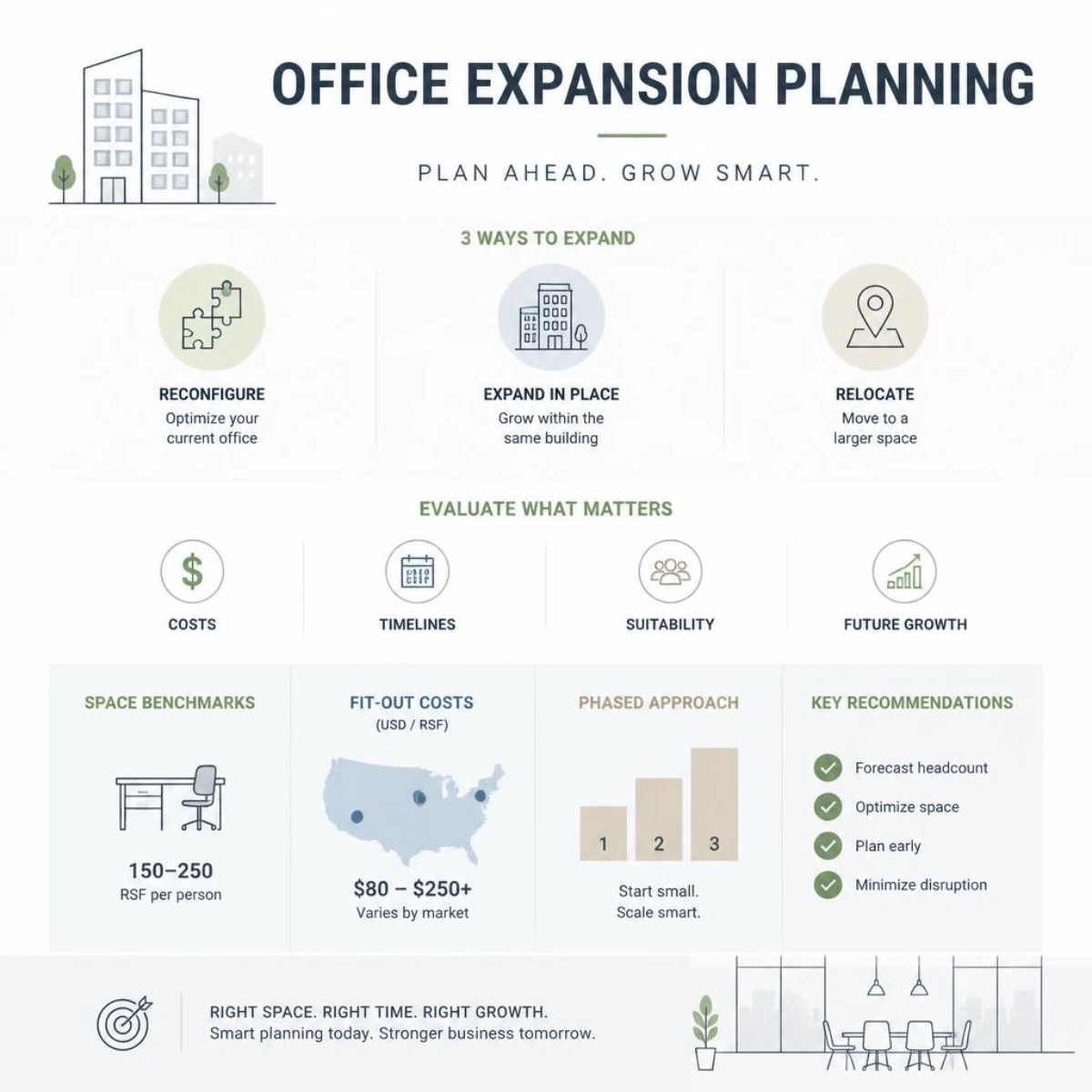
Office expansion planning is the process of evaluating and executing a company's options for acquiring more workspace, through reconfiguring existing space, expanding within the same building, or relocating to a larger footprint in order to accommodate current and projected headcount growth.
This guide is for COOs, VPs of Operations, and corporate real estate directors whose companies are growing and need more space. It covers the three main paths, how to project space needs accurately, phased fit-out strategies, cost benchmarks per sq ft across major U.S. markets, and realistic timelines from brief to handover.
What Is Office Expansion Planning?
Office expansion planning is a structured process for assessing an organization's space needs, evaluating available options (reconfiguration, within-building expansion, or relocation), projecting costs and timelines, and executing a fit-out strategy that supports growth without disrupting operations. AI Spaces supports office expansion planning for corporate clients across 49 U.S. states, from space programming and test fits through full design-build delivery.
Your Three Main Options for Office Expansion
Option 1: Reconfigure Your Current Space
Before committing to a larger footprint, assess whether your current space is actually well-utilized. Most offices that feel overcrowded are not simply too small ,they are misallocated. Common patterns: private offices at a ratio appropriate for a twice-larger firm, conference rooms that are simultaneously empty and overbooked, and storage consuming disproportionate usable square footage.
A space utilization study ,sensor or manual observation data over 3–4 weeks , will reveal how each space type is actually being used. Companies that conduct this analysis before committing to expansion typically find that reconfiguration alone can extend the useful life of their current space by 18–36 months.
What reconfiguration can and cannot do: Reconfiguration can increase seat density, convert underutilized spaces to different uses, and add acoustic infrastructure for a higher-density environment. It cannot increase total square footage, overcome fundamental structural limitations, or accommodate growth beyond approximately 30–40% above current design density.
- Cost range: $25–$75/sq ft depending on scope (furniture-only at the low end; full workstation reconfiguration with construction at the high end)
- Timeline: 8–20 weeks from project start to completion, typically phaseable within an occupied space
- Best fit: Companies that have grown 20–35% since their last space planning exercise with sufficient lease term remaining to justify the investment
Option 2: Expand Within the Same Building
If adjacent or floor-adjacent space is available in your building, a within-building expansion deserves serious evaluation before committing to relocation. Advantages: no operational disruption, no commute change for staff, leveraged lease negotiation as a known tenant, and preserved operational familiarity.
Contiguous expansion space , directly adjacent to your current footprint , is substantially more valuable than a separate floor or suite. Connecting two floors without a direct internal stair creates ongoing operational friction. Engage your landlord early, before your need becomes urgent enough to compromise your negotiating position.
In the current U.S. office market (2025–2026), expanding tenants are positioned to negotiate meaningful TI allowances for expansion space. Class A and B markets like Miami, Austin, and Nashville are seeing landlord-funded TI of $100–$160+/sq ft as incentives to retain anchor tenants.
- Cost range: $80–$150/sq ft for the expansion space before TI offset; net cost to tenant highly variable by market and lease terms
- Timeline: 16–28 weeks from lease execution to occupancy
- Best fit: Companies in buildings with available adjacent space, lease terms that allow expansion negotiation, and strong value from physical continuity with existing space
Option 3: Relocate to a Larger Space
Relocation is the highest-disruption option and frequently the most strategically sound one. It is the only option that allows you to design an office from the ground up for your current culture, work modes, headcount trajectory, and brand , without the physical and organizational constraints of the existing footprint.
A well-managed relocation involves: a space search with test fits conducted by a qualified design firm (not a broker's in-house team), TI negotiation with documented construction cost estimates, and a dual-space management plan for the period when the old lease hasn't expired but the new space is under construction.
- Cost range: $100–$180+/sq ft for a commercial-standard fit-out before TI offset; moving costs, IT migration, and overlap period add 8–15% to total project cost
- Timeline: 12-18 months from decision to occupancy (site selection, design, construction, FF&E, move)
- Best fit: Companies outgrowing their building, with a 5+ year stability horizon in their primary market, and adequate planning lead time to avoid crisis-mode decisions
How to Project Space Needs Based on Headcount Growth
The most common office expansion planning failure is designing for current headcount rather than projected headcount. A space that fits 80 people at move-in will be overcrowded within 18 months if the company grows to 120.
The Space Programming Framework
- Step 1. Establish planning horizon: Plan to a 5-year minimum. Less than 5 years risks outgrowing the space before the project pays back; more than 7–8 years produces growth projections too uncertain to design toward.
- Step 2. Document headcount by role type: Segment into full-time in-office, hybrid, remote, leadership, and support staff. Each category has different space allocation requirements.
- Step 3. Apply a utilization factor: For hybrid organizations, the average proportion of hybrid staff physically in the office on any given day. A team of 60 hybrid employees at 65% utilization requires desk supply for approximately 39 people, not 60.
- Step 4. Apply a space per person factor: See benchmarks below.
- Step 5. Apply the 5-year growth projection: Size for projected year-5 headcount with a defined plan for how initial gaps between supply and projected demand are managed.
| Configuration Type | Space per Person (incl. common areas) |
|---|---|
| Dense open plan | 120–150 sq ft/person |
| Standard open plan | 150–175 sq ft/person |
| Mixed open/private | 175–220 sq ft/person |
| Private office dominant | 220–300 sq ft/person |
| Executive / legal / financial | 250–350 sq ft/person |
Phased Fit-Out Strategies for Growing Companies
A phased fit-out allows a growing company to occupy a larger space without building out everything on day one. Two main approaches:
Shell and Core Phasing
The tenant takes possession of an unfinished space and builds out only what is immediately needed, typically 60% of the total footprint. Phase 2, triggered by headcount reaching a defined threshold, completes the remaining build-out. The Phase 1 design must plan for Phase 2 connection from the beginning. Critical: design the Phase 1/Phase 2 boundary along a corridor or demising partition, not through occupied areas.
Warm Shell with Swing Space
The landlord provides basic MEP infrastructure on the full footprint; the tenant builds out only the portions needed immediately. Unused portions serve as swing space during internal renovation until Phase 2 investment is funded. Lower capital requirement than full Phase 1 build-out; delays Phase 2 investment if growth is slower than projected.
Office Expansion Cost Benchmarks: Major U.S. Markets 2025–2026
Mid-market commercial-standard fit-out costs (before TI allowance offset):
| Market | Fit-Out Cost ($/sq ft) | Notes |
|---|---|---|
| New York City | $140–$220 | Prevailing wage; complex permitting |
| San Francisco / Bay Area | $130–$200 | High labor; seismic requirements |
| Los Angeles | $120–$185 | Seismic requirements; lower labor than SF |
| Chicago | $100–$150 | Competitive construction market |
| Miami | $95–$145 | Growing market; favorable TI environment |
| Austin | $90–$135 | High demand driving costs up; fast permitting |
| Dallas / Houston | $85–$130 | Cost-competitive; favorable permitting |
| Atlanta | $80–$125 | Cost-competitive market |
| Denver / Seattle | $100–$155 | Growing markets; labor pressure increasing |
Add 15–25% for furniture and equipment (FF&E); 8–15% for design and project management fees; 5–10% for technology and AV.
Office Expansion Timelines: Brief to Handover
| Option | Typical Duration | Key Timeline Driver |
|---|---|---|
| Full Relocation | 10–18 months | Site selection, design, permitting, construction |
| Within-Building Expansion | 5–11 months | Lease negotiation, design, construction |
| Reconfiguration | 4–7 months | Utilization study, design, phased construction |
The most reliable predictor of a troubled office expansion project is starting the process too late. The correct trigger is your projected need date minus 12–18 months for relocation, 6–12 months for within-building expansion, and 4–6 months for reconfiguration.
Frequently Asked Questions: Office Expansion Planning
- What is office expansion planning?
- Office expansion planning is the structured process of evaluating options for acquiring more workspace (reconfiguration, within-building expansion, or relocation), projecting space needs based on headcount growth, and executing a fit-out strategy that supports growth without operational disruption.
- When should we start the office expansion planning process?
- Start your planning 12–18 months before your projected need date for a full relocation, 6–12 months for a within-building expansion, and 4–6 months for reconfiguration. Most companies start 6–8 months too late and end up managing a space crisis instead of a space plan.
- How do we know how much office space we need?
- Apply a space per person factor (120–350 sq ft per person depending on configuration type) to your projected year-5 headcount, adjusted by a utilization factor for hybrid workers. A qualified workplace design firm can produce a formal space program document based on your actual headcount data and work modes.
- What is a TI allowance and how does it affect office expansion?
- A tenant improvement allowance is landlord-funded money to build out your space. In major U.S. markets in 2025–2026, TI allowances run $80–$160+ per sq ft for new leases and expansions. Maximizing your allowance requires entering lease negotiations with a documented construction cost estimate from a design firm, not a ballpark figure.
- Can we phase our office expansion to control costs?
- Yes. Phased fit-out is a well-established approach: build out the portion needed today, leave the remainder in shell or swing condition for Phase 2. The key requirements are a lease that accommodates phasing, a design that plans for the Phase 2 connection from the beginning, and a realistic plan for managing the Phase 2 construction in an occupied space.
Your expansion window is shorter than you think.
AI Spaces works with COOs, VPs of Operations, and real estate directors across 49 U.S. states to plan and execute office expansions before the timeline becomes a crisis. If you have a lease event, a headcount projection, or a board-approved growth plan, we can scope your options and give you a fixed-fee proposal within days.