Innovation
10 Office Design Trends for 2026 That Will Actually Boost Productivity and Employee Well-being

Images AI Spaces | Universal Music
If you’re tired of fluffy “office design trends 2025” lists, this FAQ turns the page. We answer the big questions leaders ask when translating Office interior design trends into measurable outcomes, productivity, retention, and brand experience, without blowing the budget or the schedule.
Strategy & ROI: Design That Pays Off
1. Which 2026 trend has the fastest ROI?
Micro-zoning. Designing for specific task modes,deep focus, team huddles, hybrid meetings, and social recharge, delivers quick wins by reducing noise conflicts and context switching.
- Action: Start with a floorplate “mode map,” redistribute seating based on real utilization, and treat focus rooms like critical infrastructure, not leftovers.
2. How do I prove a trend isn’t just décor?
Tie each intervention to an operational metric: time-to-first-available focus room, meeting effectiveness scores, or average time to reconnect after interruptions. Establish a four-week baseline, pilot one neighborhood, then publish a one-page results brief to stakeholders.
3. What’s the right split between collaboration and focus?
Plan 60/40 as a starting point, then tune by team. Engineering and finance typically need more focus rooms, while sales and product teams lean toward collaborative spaces. Warning: Over-indexing on collaboration creates noise and drives WFH days, undercutting your occupancy plan.
4. How do I budget for trends without scope creep?
Bundle trend-driven upgrades into two work packages: (1) critical performance (acoustics, lighting, HVAC controls) and (2) brand/amenity (materials, plants, signage). Lock acceptance criteria early (e.g., NC-35 background noise) so design choices are evaluated on performance, not taste.
Health & Well-being
5. What’s the smartest investment for well-being in 2026?
Acoustic comfort. It’s the foundation for cognitive performance, call privacy, and meeting quality. Prioritize high-STC doors and ceiling absorption over open benching. Pair this with a behavioral norm: headsets should be optional, not mandatory.
6. Does biophilic design still matter?
It is still relevant, but only when it’s programmatic, not decorative. Use plants and natural materials to define circulation, buffer pods, or cue zones. Think “bio/logic”: nature supporting wayfinding, acoustics, and stress regulation.
7. Sit-stand desks for all, or only some?
Mix them. Provide height-adjustable surfaces in shared focus rooms and high-use individual stations, plus a few per neighborhood. This delivers mobility and comfort without the all-in cost.
Technology & Flexibility
8. How do sensors change planning this year?
Deploy privacy-safe utilization sensors to verify seat and room demand by hour and by team. Use 8–12 weeks of data to tune the mode mix, then publish a “space tuning release note” so teams understand the why of the changes.
9. What’s new in hybrid meeting rooms?
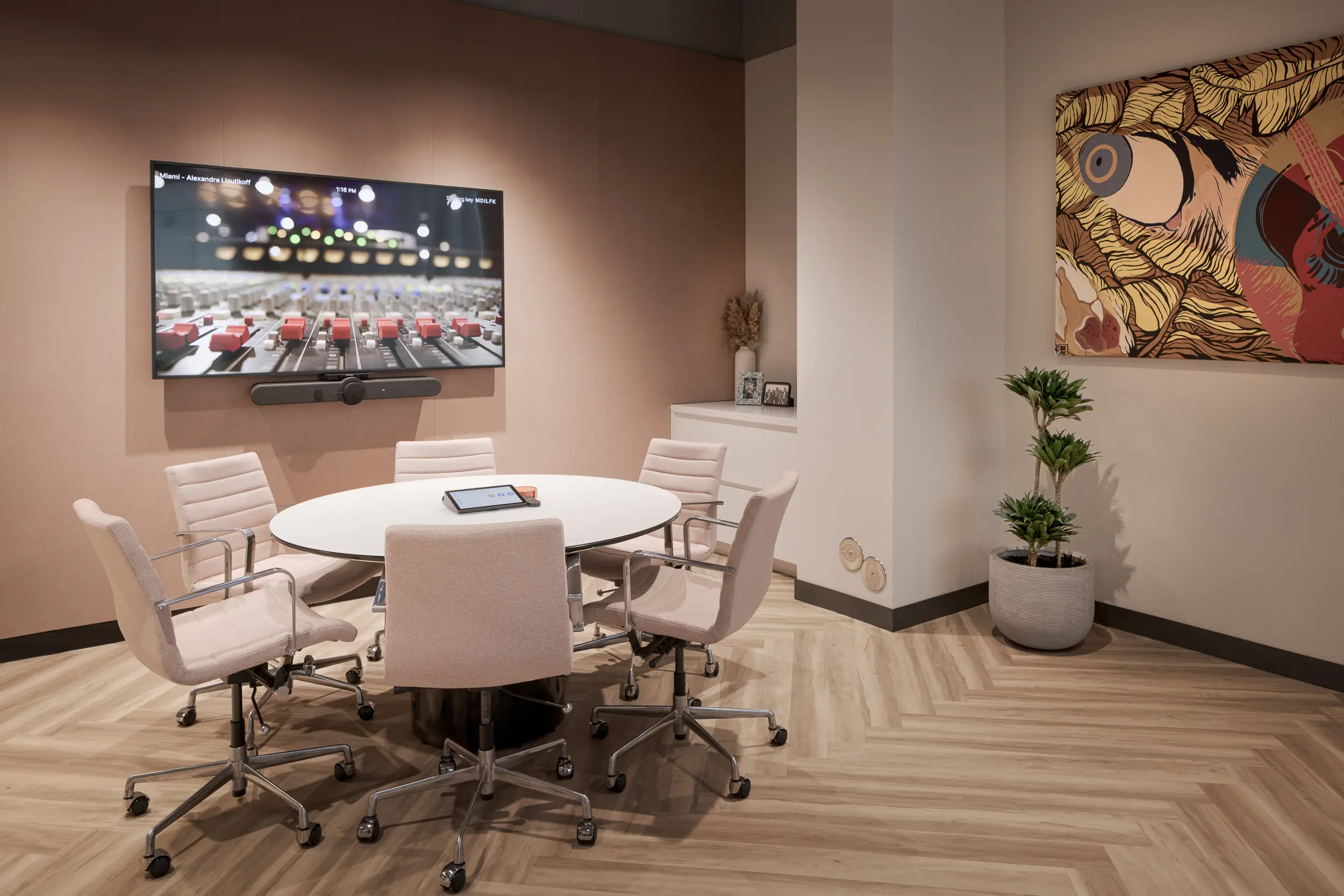
Look for “Camera-first” rooms with front-row displays at eye level and table mics replaced by beamforming ceiling arrays. Default to a clear tiered system, phone booth, 2–4p focus, 6–8p hybrid, 10–12p boardroom—to end "room roulette".
10. Are movable walls worth it?
Where change is frequent, yes. Demountable partitions reduce churn costs and waste in agile neighborhoods. However, use fixed construction for core rooms (IT, mother’s rooms) where isolation is critical.
Sustainability & Materials
11. How do we embrace circularity without sacrificing aesthetics?
Specify remanufactured task chairs, carpet tile take-back programs, and modular furniture with replaceable parts. Aesthetics should follow from curated palettes and consistent profiles, not just newness.
12. What should we do about greenwashing?
Adopt a “proof or pass” rule. Ask for third-party certifications (e.g., EPDs, Declare labels). If claims aren’t verifiable, specify alternates to keep procurement honest.
Build & Operations: Avoiding Delays
13. What’s the #1 cause of schedule slip?
Late IT/AV integration. Involve AV at the same milestone as partitions and ceilings. Close microphone and camera locations before electrical rough-in to validate acoustics and sightlines.
14. How do we keep changes from spiraling?
Use a change guardrail: anything that touches life-safety, MEP capacity, or acoustic assemblies needs a written RFI and cost impact. Cosmetic swaps should ride a weekly “batch change” to preserve budget sanity.
People & Culture
15. How do we reflect brand without dating the space?
Anchor brand in form, proportion, and material logic, not transient colors. Your brand should read through experience quality, not just a paint code.
16. How do we involve employees efficiently?
Run targeted co-creation: a short survey for pain points and a workshop per department to validate adjacencies. People support what they help shape, within a clear decision framework.
Ready to Translate Trends into Performance?
If you lead workplace design, we can help you run a rapid pilot, mode map, and acoustic tuning.
Next Quarter Actions:
- Measure Reality: Run an 8-week utilization study.
- Pilot & Iterate: Convert one neighborhood and test a camera-first room.
- Procure Smart: Lock long-lead items and request EPD-backed alternates.
Contact us to prove value in 90 days.

More Articles to Keep Designing Your Workspace
Guides, inspiration and workspace ideas