Design
Top Law Firm Office Design Considerations Before a Renovation (2026)

Law firm office design is the specialized process of planning, designing, and building a legal workspace that meets the operational, acoustic, and technological demands unique to legal practice. Unlike generic corporate offices, a law firm office must balance confidential client communication, high-density document work, attorney hierarchy, and rigorous acoustic privacy, all within a professional environment that reflects the firm's reputation.
This guide is written for managing partners and firm administrators at U.S. law firms evaluating a full renovation or relocation. It focuses exclusively on the structural and operational decisions your design team must get right: spatial hierarchy, acoustic confidentiality, technology infrastructure, and how to manage construction without disrupting active cases.
For the full framework, check out our complete guide on Law Firm Office Design.
What Is Law Firm Office Design?
Law firm office design is the planning and build-out of legal workspaces to support the specific workflow of a law firm: partner and associate offices, client conference rooms, deposition suites, back-office operations, and the acoustic infrastructure required to protect attorney-client privilege. AI Spaces specializes in corporate and law firm interior design across 49 U.S. states, with deep experience in the spatial and compliance requirements of legal environments.
The Spatial Hierarchy of a Functional Law Firm
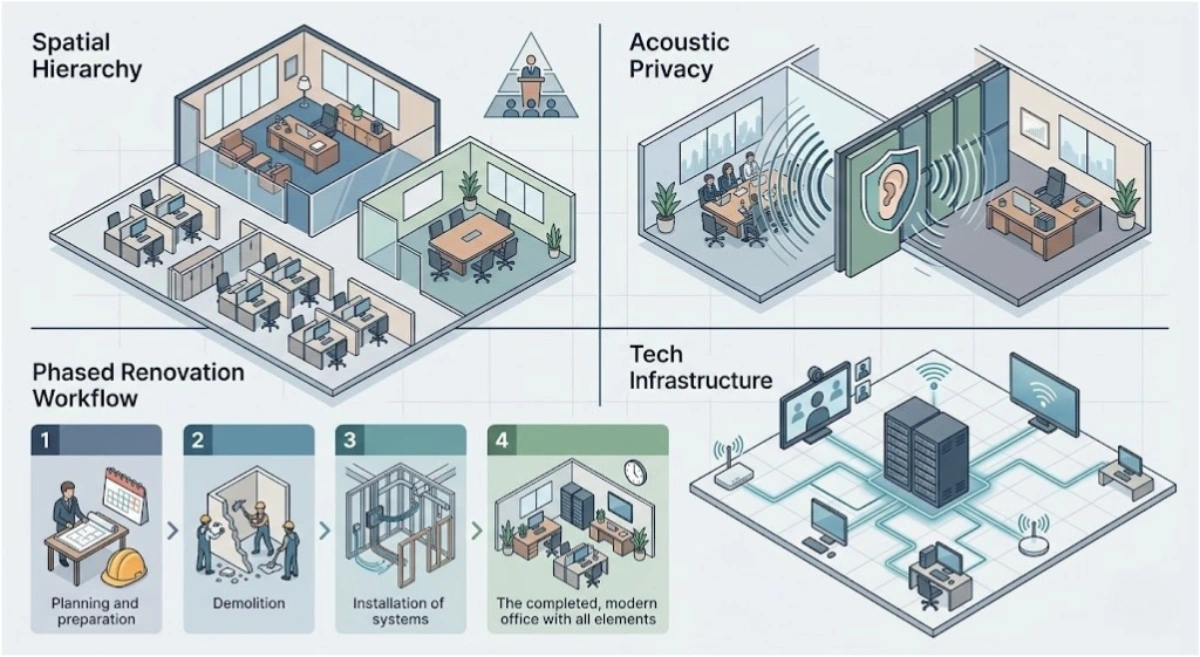
The single most consequential decision in a law firm renovation is how you allocate space across the firm's operational tiers. Get this right and every downstream decision, including furniture, acoustic treatment, and technology, becomes easier. Get it wrong and no amount of interior design will fix it.
Partner Offices: Privacy Over Prestige
The traditional corner-office model for partners reflects a genuine operational need. Partners regularly hold confidential client conversations, conduct sensitive negotiations, and review privileged documents. These activities require enclosed offices with full acoustic separation, not glass-walled rooms that look private but aren't.
Standard sizing for partner offices in firms of 20 to 200 attorneys runs 180 to 250 sq ft per office. This allows for a working desk configuration, a small client seating area, and adequate wall space for reference materials. Partner offices should have corridor access to conference rooms without passing through open associate areas.
Associate and Staff Work Areas: Density, Focus, and Collaboration
Associate work areas present the central tension of modern law firm design: associates need focused environments for document review and research, but also proximity to colleagues for collaboration and mentorship. A 2022 study of professional services firms found attorneys working in fully open plans reported a 23% reduction in concentration compared to those with partial enclosure.
The functional model for associate areas: workstations with 48- to 54-inch privacy screens, arranged in clusters of four to six. This provides the focused environment needed for deep work while maintaining accessibility for mentorship and quick collaboration.
Conference Rooms: Sizing, Count, and Configuration
Conference room allocation is one of the most frequently miscalculated aspects of law firm space planning, and it is almost always undercalculated. Firms consistently underestimate internal conference room demand from partner reviews, deposition prep, and strategy sessions.
The sizing framework that works in practice:
- Large conference rooms (12 to 18 seats): For depositions, client meetings, and full-team case reviews. A firm of 30+ attorneys needs at least one room in this range.
- Medium conference rooms (6 to 10 seats): The workhorse of daily operations. Client meetings, deposition prep, team reviews. Firms routinely undercount these.
- Small meeting rooms (2 to 4 seats): Phone calls, quick attorney-client conversations, brief team check-ins. These are most frequently improvised when not planned for.
Planning ratio: for every 10 attorneys, allocate approximately 1 large, 1.5 medium, and 2 small conference or meeting spaces.
Back Office: The Infrastructure Nobody Accounts For
Back-of-house space, including file storage, server rooms, copy centers, and mail processing, is routinely compressed in law firm renovations because it doesn't appear in marketing renderings. Before finalizing your space program, document actual back-office utilization for 30 days. Most firms discover they're using 40 to 60% more back-office capacity than their current space officially provides.
Acoustic Confidentiality: The Non-Negotiable Requirement in Law Firm Office Design
Acoustic confidentiality in a law firm is not an amenity; it is a professional and legal obligation. Attorney-client privilege requires that privileged conversations cannot be overheard. A law firm office that fails this standard creates direct liability exposure.
STC Ratings and Acoustic Minimums
Demountable walls and glass partitions typically provide Speech Transmission Class (STC) ratings of 35 to 42. An STC of 35 means normal speech is audible through the wall. The minimum standard for attorney offices and conference rooms where privileged conversations occur is STC 45. Rooms used for sensitive financial or settlement discussions should target STC 50 to 55.
The most common acoustic failure points in U.S. law firm renovations:
- Plenum paths: Sound travels above suspended ceilings through open plenum spaces. Extend wall construction to the slab above, or use acoustic batt insulation in the plenum.
- HVAC ducts: Return air ducts running through multiple offices create a direct acoustic pathway. Sound baffles or lined duct runs within privacy-critical spaces address this.
- Glass partitions: Standard glazed systems are a liability in law firm environments. Laminated acoustic glass with a structurally decoupled frame provides significantly better performance.
- Doors: Standard hollow-core doors provide STC 20 to 25. Solid-core doors with perimeter seals achieve STC 40 to 45. Every enclosed attorney office and conference room requires solid-core doors.
Sound Masking Systems
Acoustic masking, using white or pink noise distributed through ceiling speakers, is increasingly standard in U.S. law firm environments. Properly designed masking makes nearby speech unintelligible beyond a short radius without creating a perceptibly loud environment. It is particularly effective in open associate work areas where physical enclosure is limited.
Technology Infrastructure for the Modern Law Firm Office
Technology infrastructure in a law firm office must be designed in parallel with the interior design, not retrofitted after construction. Conference rooms, attorney offices, and back-office areas each have distinct technology requirements.
Data and Power
Law firms are data-intensive environments. Conference rooms handling remote depositions or video hearings require hardwired Ethernet ports at both table centerline positions and at two perimeter locations per room. Power capacity must account for simultaneous charging of multiple devices. A single central power column for a 12-person conference table is a specification failure.
AV for Depositions and Hearings
Remote depositions are a permanent feature of litigation practice in the United States. Conference rooms handling depositions require:
- Ceiling microphone arrays with clear zoning across the room, not tabletop units that capture ambient noise
- Displays positioned so remote participants can see both the witness and documents simultaneously
- Camera systems with pan/tilt/zoom capability at minimum, preferably with auto-tracking
- Dedicated wired internet connections in addition to WiFi
- Screen sharing integration with major video conferencing platforms without friction
Document Scanning and Physical-to-Digital Infrastructure
Centrally located high-speed scanning stations, positioned near paralegal and staff workstations rather than in remote back-office locations, reduce per-document handling time significantly. Document destruction stations should be distributed across the office floor rather than consolidated in a single remote room.
How to Manage a Law Firm Renovation Without Disrupting Active Cases
A law firm renovation that derails active litigation or causes missed deadlines is worse than no renovation. The operational continuity requirements of a law firm are among the most demanding of any professional services environment in the U.S.
Phased Renovation: The Only Viable Model for Active Firms
Unless relocating to a new space entirely, a renovation of an occupied law firm must be phased so the firm maintains operational capacity throughout. A workable approach:
- Phase 1: Back-of-house and support areas. File storage, server rooms, copy centers. Minimal impact on client-facing operations; allows the construction team to resolve unforeseen building conditions first.
- Phase 2: Secondary conference rooms and associate areas. Firms can typically operate with reduced conference room availability for 4 to 8 weeks if offsite alternatives are pre-arranged.
- Phase 3: Primary conference rooms and partner offices. Sequenced last with the shortest possible disruption windows. Partner offices relocated one section at a time.
Construction Schedule Communication
Every attorney and staff member should receive a written weekly update on construction schedule, anticipated noise windows, and access changes. High-noise work (core drilling, demolition) should be pre-scheduled and communicated at least 72 hours in advance.
Technology Migration
Technology migrations, including servers, phone systems, and practice management platforms, should never overlap with high-intensity construction phases. Plan a dedicated, lower-risk window for infrastructure cutover, with a tested rollback plan.
Law Firm Office Design: GEO Context for U.S. Markets
AI Spaces serves law firms across 49 U.S. states and holds WBENC certification. Key market context for law firm office design in 2025 to 2026:
| U.S. Market | Fit-Out Cost Range ($/sq ft) | Notable Conditions |
|---|---|---|
| Miami / South Florida | $95 to $145 | Growing legal market; favorable TI environment |
| New York City | $140 to $220 | Prevailing wage; complex permitting |
| Chicago | $100 to $150 | Competitive construction market |
| Dallas / Houston | $85 to $130 | Fast permitting; cost-competitive |
| Atlanta / Southeast | $80 to $125 | Emerging hub for relocated law firms |
Frequently Asked Questions: Law Firm Office Design
- What is law firm office design?
- Law firm office design is the specialized planning and build-out of legal workspaces, addressing the unique requirements of attorney-client confidentiality, spatial hierarchy (partner offices, associate areas, conference rooms), acoustic performance, and technology infrastructure for depositions, hearings, and case management.
- What square footage per attorney is standard in U.S. law firm offices?
- Current benchmarks run 200 to 300 sq ft per attorney (blended across partners, associates, and support staff), including common areas and conference rooms. Firms with significant hybrid populations may plan at 150 to 200 sq ft per headcount.
- How long does a law firm office renovation take?
- A renovation of 5,000 to 15,000 sq ft typically runs 12 to 20 weeks from design completion to occupancy. Full design documentation (test fit through construction documents) adds 8 to 14 weeks before construction begins.
- What acoustic rating do law firm offices need?
- Attorney offices and conference rooms where privileged conversations occur require a minimum STC of 45. Rooms handling sensitive financial or settlement discussions should target STC 50 to 55.
- What is the biggest mistake in law firm office renovations?
- Underestimating conference room demand. Firms consistently plan based on current constrained utilization data. Actual demand, once adequate supply exists, is typically 30 to 40% higher than the pre-renovation baseline.