Design
The First 30 Seconds: How Emerging Law Firms Use High-Impact Design to Compete with Big Law

AI SPACES | LEGAL BRANDING | APRIL 2026
There is a moment that every partner in an emerging law firm knows well. A prospective client, exactly the kind of client the firm has been positioning itself to serve, walks through the door for a first meeting. Before a word is spoken, before credentials are presented, before the quality of the legal thinking in the room has any opportunity to register, the space makes its case. Or it doesn't.
This is the competitive disadvantage that most emerging and mid-size law firms live with and rarely address directly: the physical environment of a large, established firm carries an implicit credibility that decades of investment have built. The marble lobby, the floor-to-ceiling city views, the hushed confidence of a space that has clearly been designed with intention, these things communicate authority in ways that are felt before they are consciously processed.
What we have learned at AI Spaces, after designing legal environments at every scale across Miami and Latin America, is that this gap is closeable. Not through budget alone, a growing firm cannot simply outspend an established one, but through design intelligence. Through understanding precisely which design decisions create the impression of authority and applying them with discipline, regardless of square footage or total investment.
This article is about how to do that. Specifically, how to use scale, symmetry, materiality, and spatial strategy to project the same authority as a firm three times your size, and how to do it in a way that is authentic to who you are and sustainable as you grow.
For the full framework, check out our complete guide on Law Firm Office Design.
Scale: The Misunderstood Variable
Before addressing the design toolkit, it is worth understanding what is actually happening in the first thirty seconds of a client's arrival. The cognitive science here is well-established and directly relevant to design decisions.
The most common misconception about competing with large firms through design is that the competition is about size, that a smaller firm cannot project the same authority because it simply has less space to work with. This is wrong, and understanding why it is wrong is the first step to closing the gap.
Scale in design is not about the absolute size of a space. It is about the relationship between a space and the human being experiencing it. A small reception area with a ten-foot ceiling, a full-height feature wall, and furniture scaled to create a sense of arrival will register as more authoritative than a large reception area with an eight-foot ceiling, generic furniture, and no focal point, even though the large space has more square footage.
The practical application of this principle for emerging law firms:
- Invest in ceiling height wherever the building allows, even a six-inch increase in perceived ceiling height, achieved through lighting placement, wall paneling, or mirror, has a measurable effect on perceived authority
- Use full-height elements, floor-to-ceiling millwork, full-height doors, ceiling-mounted pendant fixtures, to draw the eye upward and create a sense of vertical scale
- Size furniture to the room rather than to convention, a reception desk that is proportionally scaled to the space reads better than a standard-specification desk that leaves the room feeling unresolved
- Create a single powerful focal point, a feature wall in a premium material, a piece of art scaled to the space, or a sculptural reception desk, that anchors the room and gives clients something definitive to respond to
Symmetry as a Signal of Control
Symmetry is one of the most powerful and underused tools available to emerging law firms competing on design. It is free, it costs nothing beyond the decision to apply it, and its effect on the perception of authority is immediate and profound.
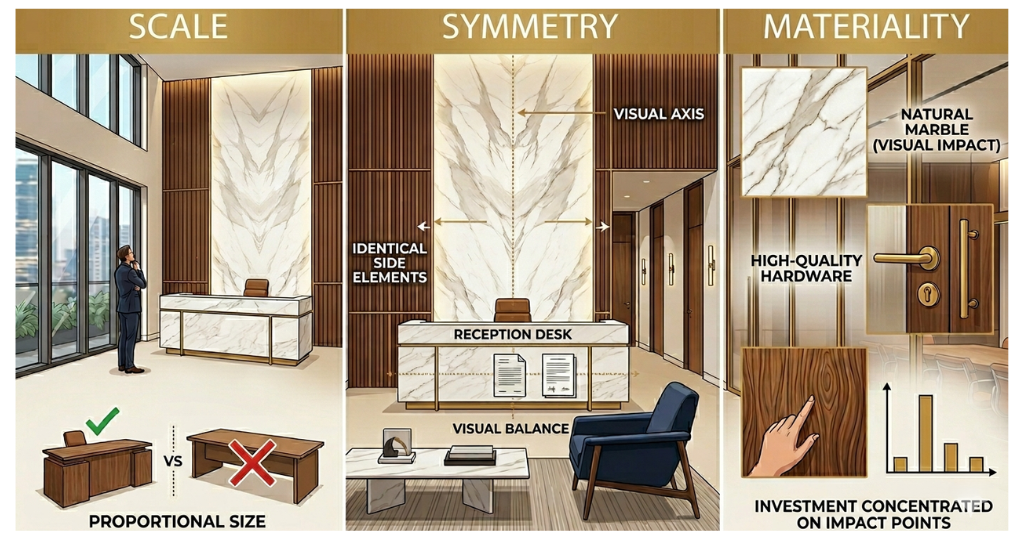
In the context of legal environments, symmetry communicates control. A reception desk centered on the back wall, flanked by identical elements on each side, reads as a firm that exercises the same precision in its spatial organization as it does in its legal arguments. A conference room with the table centered in the space, lighting aligned with the table axis, and identical conditions on each side of the room tells clients, before a word is spoken, that this is an organization that pays attention to detail.
The application of symmetry in legal design:
- Reception desk placement, centered on the primary view axis from the entrance, with symmetrical flanking elements (millwork panels, lighting fixtures, artwork) that reinforce the central focal point
- Conference room layout, table centered in the room with equal clearance on all sides, lighting fixtures aligned with the table centerline, identical seating on both sides
- Partner office design, symmetrical millwork walls with centered desk placement communicate hierarchy through spatial order rather than size alone
- Corridor composition, where the firm has a primary circulation corridor, symmetrical door placement and consistent wall treatment along its length create an impression of organizational coherence that clients process as competence
Materiality: The Highest-Leverage Investment
If emerging law firms have one design mistake in common, it is distributing material investment evenly across the space rather than concentrating it where it creates the most impact. The result is a space where everything is acceptable and nothing is remarkable, an environment that registers as neither poor nor distinguished, which in a competitive context is effectively the same as poor.
The strategic application of materiality for an emerging firm works on a simple principle: invest heavily in the surfaces clients touch, see at close range, and photograph, and use more restrained specifications everywhere else. The hierarchy of investment should follow the hierarchy of client exposure.
In practice, this means:
- The reception desk surface, the first physical element a client touches or approaches closely, in natural stone, solid wood, or a premium composite that communicates quality unmistakably
- The conference room table, the surface around which the firm's most important conversations happen, in a material that rewards close inspection: book-matched veneer, solid stone, or high-quality lacquer
- The primary feature wall in reception, the element that appears in every photograph and every video call background, in a material with genuine depth and texture: fluted wood panels, dimensional plaster, or stone
- Hardware throughout client-facing areas, door handles, cabinet pulls, and lighting fixtures, in a single consistent metal finish that reads as deliberate rather than default
The Lobby as a Competitive Tool
For an emerging law firm, the lobby, or in many cases, the reception area that functions as the de facto lobby, is the single most important competitive tool available through design. It is the environment where the gap between an emerging firm and an established one is most visible, and therefore where design investment creates the greatest competitive return.
The elements of a reception area that, combined, allow an emerging firm to project authority at the level of a much larger competitor:
- A reception desk designed as an architectural object rather than a furniture specification, custom millwork in a premium material, with proportions calibrated to the specific space
- A back wall designed as a singular, considered statement, dimensional lettering in a refined metal finish, set against a wall treated in a material or finish that rewards attention
- Lighting that is warm, layered, and controlled, ambient light from carefully positioned fixtures, accent light on the feature wall, and task light at the reception desk, all on a single control system
- Seating that is genuinely comfortable and visually coherent, a curated selection of two to four pieces in complementary finishes, scaled to the space and positioned to create a sense of welcome rather than waiting
- Silence, acoustic management through ceiling treatment, soft furnishings, and layout that ensures the reception area is quiet, private, and free from the ambient noise of the working office behind it
Growing Into the Design: Building for the Firm You Will Become
One of the unique design challenges for emerging law firms is the need to design for two timelines simultaneously, the firm as it exists today, and the firm it is actively becoming. An office designed too tightly around current headcount and practice areas will require disruptive renovation precisely at the moment when growth is accelerating, the worst possible time to take space offline.
Designing for growth means making the permanent elements of the space, the reception, the primary conference room, the architectural bones, at the quality level of the firm's ambition, not its current scale. It means specifying infrastructure that can accommodate additional workstations, practice groups, and technology without reconstruction. And it means leaving deliberate flexibility in the working areas while holding the standard in the client-facing zones.
The firms that do this well are the ones that, when they reach the scale of their larger competitors, find that their environment already reflects that scale, because it was designed for it from the beginning. The alternative is a firm that achieves the clients and the revenue of a major player while still operating in a space that communicates a much earlier chapter of its story.
The First 30 Seconds Are Winnable
The authority that large established law firms project through their physical environments is real, and it is built on genuine investment over many years. But it is not beyond the reach of an emerging firm with a clear design strategy and the discipline to apply it consistently.
The firms that close this gap most effectively are not the ones with the largest design budgets. They are the ones that understand exactly which design decisions create authority, scale, symmetry, concentrated materiality, acoustic control, and a reception that functions as an architectural statement, and apply those decisions with precision in the spaces where clients spend their time.
A client who walks into a well-designed emerging firm reception area does not think 'this is a small firm trying to look larger.' They think 'this is a firm that pays attention.' That perception, formed in the first thirty seconds and reinforced at every subsequent visit, is the foundation on which client relationships are built, retained, and grown.
At AI Spaces, designing legal environments that create this perception, for firms at every stage of their development, is one of our core areas of expertise. We understand the specific design decisions that move the needle for emerging firms, and we know how to apply them in a way that is proportional to the investment and authentic to the firm's identity.
Ready to make your first impression count? Book a free law firm design consultation with AI Spaces at aispaces.ai

More Articles to Keep Designing Your Workspace
Guides, inspiration and workspace ideas