Design
Best Workplace Design: 5 Principles Behind Offices That Actually Drive Performance 2026

The best workplace design is not the one with the most striking aesthetic. It is the one that measurably improves productivity, reduces voluntary turnover, and supports the full range of work modes employees need throughout the day. Research published in the Journal of Environmental Psychology and CBRE's workplace benchmarking studies consistently shows that well-designed environments account for 10–25% variance in individual productivity depending on role type.
This article is for workplace managers, HR directors, and COOs who want to understand what genuinely excellent workplace design looks like in 2026, not as a trend piece, but as a performance framework. We cover the five core principles behind the best-performing offices, real project examples applying each, how to measure whether your workplace design is working, and the critical difference between a space that photographs well and one that actually drives results.
What Is Best Workplace Design?
Best workplace design refers to office environments intentionally designed to optimize employee performance, wellbeing, and collaboration through evidence-based planning, acoustic engineering, biophilic elements, flexible infrastructure, and technology integration. AI Spaces designs best-in-class corporate workplaces for clients across 49 U.S. states, pursuing LEED and WELL building standards as part of its wellness-focused design practice.
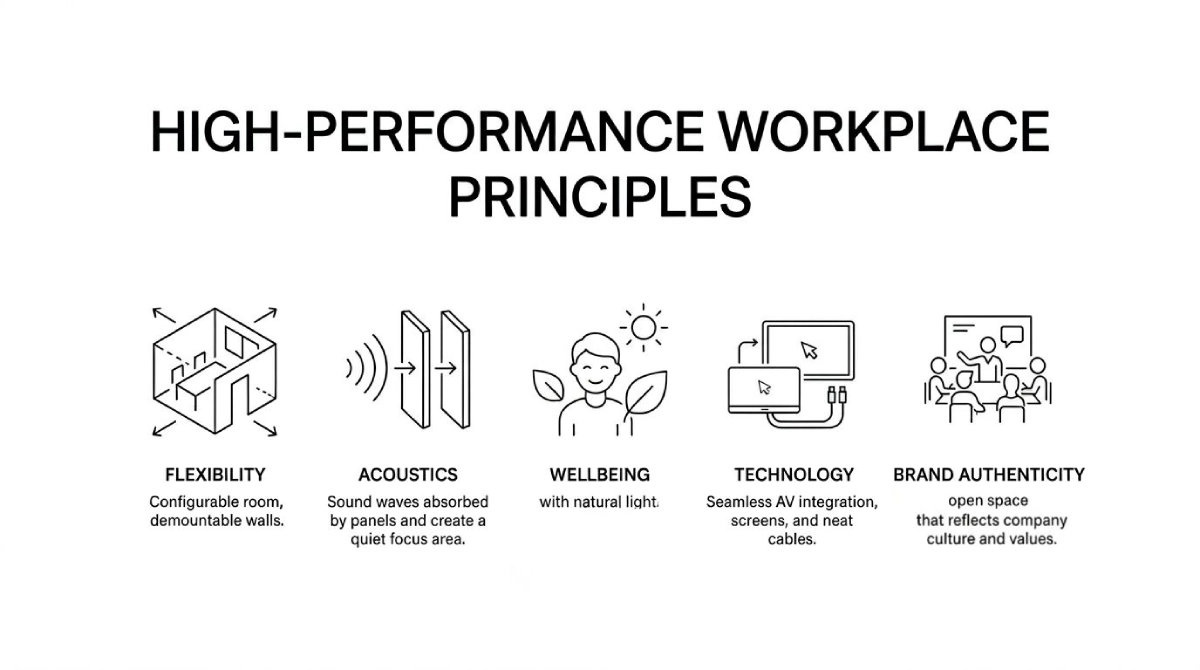
Principle 1: Flexibility Is Built In, Not Added Later
Flexibility in workplace design means the physical environment can accommodate changes in team size, work mode, and organizational structure without requiring construction. Most offices that struggle with flexibility were designed with great specificity for one organizational moment, and could not adapt when the organization changed.
What Genuine Built-In Flexibility Looks Like
- Furniture systems on a 24-inch planning grid so reconfiguration maintains alignment with structural and MEP infrastructure without custom solutions.
- Power and data at floor and ceiling, not only at fixed workstation locations.
- Lighting systems with zoned control rather than whole-room circuits.
- Demountable wall systems instead of drywall. The 40–60% cost premium pays back when reconfiguration is needed within 3–5 years.
How to measure it: A space is flexible if it can be meaningfully reconfigured to support different team sizes and work modes without a permit or a contractor. If reconfiguration requires construction, flexibility was not designed in.
AI Spaces Project Application
In a 22,000 sq ft corporate headquarters in Miami, AI Spaces specified a fully demountable partition system throughout all perimeter and internal office walls. Eighteen months after occupancy, the client reorganized two entire departments. The reconfiguration was completed over a single weekend without construction, at roughly 15% of the cost of a drywall renovation.
Principle 2: Acoustic Performance Is Treated as Infrastructure
Noise is the most consistently cited driver of workplace dissatisfaction across job types, industries, and office configurations in U.S. corporate environments. It is also the most consistently under-addressed element in workplace design, primarily because acoustic treatment is invisible in renderings and is the line item most frequently cut when a project goes over budget.
The Four-Component Acoustic Framework in Best Performing Offices:
- Absorption: High-NRC ceiling tiles (NRC 0.75+), fabric-wrapped wall panels, carpet and soft furnishings in open areas. Reduces reflected sound within the space.
- Blocking: Full-height walls extending to the deck (not just to the suspended ceiling) for enclosed rooms. Solid-core doors with perimeter seals. Acoustic glass for glazed conference rooms.
- Covering: Sound masking systems that raise the ambient noise floor and reduce the intelligibility of nearby speech. Modern systems are effectively inaudible as distinct sounds.
- Spatial planning: Locating loud collaborative zones away from focus-work areas. Creating acoustic transition zones between spaces with different requirements.
How to measure it: Post-occupancy surveys in which 80% or more of occupants report acoustic conditions do not impair their ability to concentrate during focused work sessions.
Principle 3: Wellbeing Is Embedded in the Built Environment
Wellbeing in the best workplace designs is not a wellness room or a plant in the lobby. It is a set of specific physical interventions with documented performance outcomes. The WELL Building Standard, which AI Spaces pursues for eligible projects, quantifies these interventions across light, air, water, nourishment, movement, thermal comfort, and sound.
Evidence-Based Wellbeing Interventions
- Biophilic elements: Research from the Human Spaces report found employees in environments with natural light reported 51% lower rates of eyestrain and 63% lower rates of headaches. Intentional orientation of workstations toward natural light and strategic placement of living plant material are baseline interventions.
- Movement integration: Spatial design that makes incidental movement part of the daily workflow, stairs positioned as the obvious path between floors, coffee and social areas distributed across the floor plate requiring a walk from primary workstations.
- Ergonomics by default: Sit-stand desks, ergonomic seating, properly specified monitors, and adequate task lighting are base standards for every workstation, not amenities for select employees.
- Respite spaces: Lower-stimulus areas with a genuinely different visual and acoustic environment from primary work areas, not open lounges that function as additional work areas with softer furniture.
How to measure it: Absenteeism rates and voluntary turnover data compared to industry benchmarks. Organizations in WELL-certified environments consistently see measurable improvement in both.
Principle 4: Technology Integration Is Seamless, Not Supplemental
Technology integration in the best workplace designs is not a feature added after design is complete. It is a design requirement that runs in parallel from the first programming meeting. The most common technology failure in corporate offices is not the technology itself; it is the integration. The AV works; the cable management makes it inaccessible. The conference system is best-in-class; the camera position makes every remote participant feel filmed from below.
What Seamless Technology Integration Requires
- Infrastructure-first planning: power, data, and AV rough-in specified during design development, before finishes are selected.
- Room-specific AV design: a 12-person boardroom has fundamentally different specifications than a 4-person huddle room.
- Platform standardization: any employee should be able to walk into any conference room and start a meeting without a learning curve.
- Visible infrastructure management: cable management and charging access designed as finished elements, not afterthoughts.
How to measure it: Time-to-start for conference room meetings. The industry benchmark for well-integrated spaces is under 90 seconds from scheduled start to active meeting. Poorly integrated spaces average 5–10 minutes of setup time, consuming measurable productivity across every meeting day.
Principle 5: Brand Identity Is Spatially Authentic
Brand identity in the best workplace designs is not logo placement or brand color on accent walls. It is the degree to which the physical environment accurately communicates the organization's actual culture, values, and ways of working. A spatial brand contradiction, an organization that claims transparency but designs physically separated executive areas, or claims collaboration while providing no spaces that support it, undermines both the design and the organizational narrative.
What Authentic Spatial Brand Expression Involves
- Cultural values expressed in spatial hierarchy: Genuinely flat cultures should have spatial hierarchy that reflects this, reduced private executive offices, accessible leadership areas, no physical separation between management and staff.
- Material choices that reflect organizational character: Solid wood over laminate, natural stone over composite, metal over plastic, for firms whose culture emphasizes craft and quality. The material palette communicates the organization's relationship to quality in ways verbal branding cannot.
- Space programming that matches stated culture: If innovation is a named value, the space program should include spaces that enable experimentation, writable surfaces, flexible furniture, informal collaboration areas that feel distinct from the primary work environment.
How to measure it: Post-occupancy evaluation responses to "Does this office reflect who we are?" Alignment between expressed organizational values and spatial experience consistently correlates with higher belonging scores and lower voluntary turnover in AI Spaces post-occupancy surveys.
How to Measure Whether Your Workplace Design Is Working
Three practical measurements provide a performance baseline for any corporate office:
| Measurement | What It Reveals | Signal to Watch For |
|---|---|---|
| Space utilization data | Whether different room types are used at expected rates | Consistent underuse signals misallocation; overuse signals undersupply |
| Post-occupancy survey | Whether the space supports actual work modes | Low scores on focused work, collaboration, or calls |
| Meeting effectiveness | Time lost to technology failures and acoustic disruptions | Average start time exceeding 90 seconds per meeting |
Together these give you a performance baseline against which a renovation investment can be evaluated. High-performing workplace design consistently shows measurable improvement on all three metrics within 6–12 months of occupancy.
Frequently Asked Questions: Best Workplace Design
What is best workplace design?
Best workplace design refers to corporate offices designed around evidence-based principles, flexibility, acoustic performance, wellbeing, technology integration, and brand authenticity, that measurably improve productivity, reduce turnover, and support the full range of employee work modes.
What does the best workplace design look like in 2026?
In 2026, the best workplace designs prioritize activity-based planning (different zones for different work modes), acoustic infrastructure as a baseline, biophilic elements for wellbeing, seamless AV integration, and spatial expressions of brand culture. They are designed from utilization data, not from aesthetic trends.
How do I know if my current office is well-designed?
Run three measurements: space utilization rates by room type, a post-occupancy survey on whether the space supports employees' actual work modes, and an audit of daily meeting start times. These reveal where the design is underperforming against employee needs.
Does workplace design affect employee retention?
Yes. Research from CBRE and the Human Spaces report consistently links well-designed physical environments to lower voluntary turnover rates, higher engagement scores, and reduced absenteeism. The physical workplace is a retention variable, not just a facilities decision.
What is the ROI of investing in better workplace design?
CBRE benchmarks fit-out investment at roughly 3–5% of annual people costs. The productivity, retention, and absenteeism improvements associated with high-performing design return 100–300% of that investment within three years, depending on pre-renovation baseline.
See our workplace portfolio at aispaces.ai/portfolio