Before Hiring a Commercial Office Fitout Company, Read This First

Cover image of the Veccina project by Santiago Muñoz.
Commercial office fitout is one of the most complex construction projects a Florida business will manage. Unlike a residential renovation or a simple office refresh, a full commercial fitout involves coordinating architecture, structural work, mechanical and electrical systems, permitting across multiple agencies, furniture procurement with long lead times, and technology infrastructure, often under a lease commencement deadline that does not move.
Businesses in Miami, Orlando, Tampa, and across South Florida's commercial growth corridors are navigating this process constantly. The ones that do it well, staying on schedule, on budget, and with a workspace that actually performs, have one thing in common: they ask the right questions before signing a contract with a fitout company. This article covers exactly those questions.
What Is a Commercial Office Fitout, and What Should It Include?
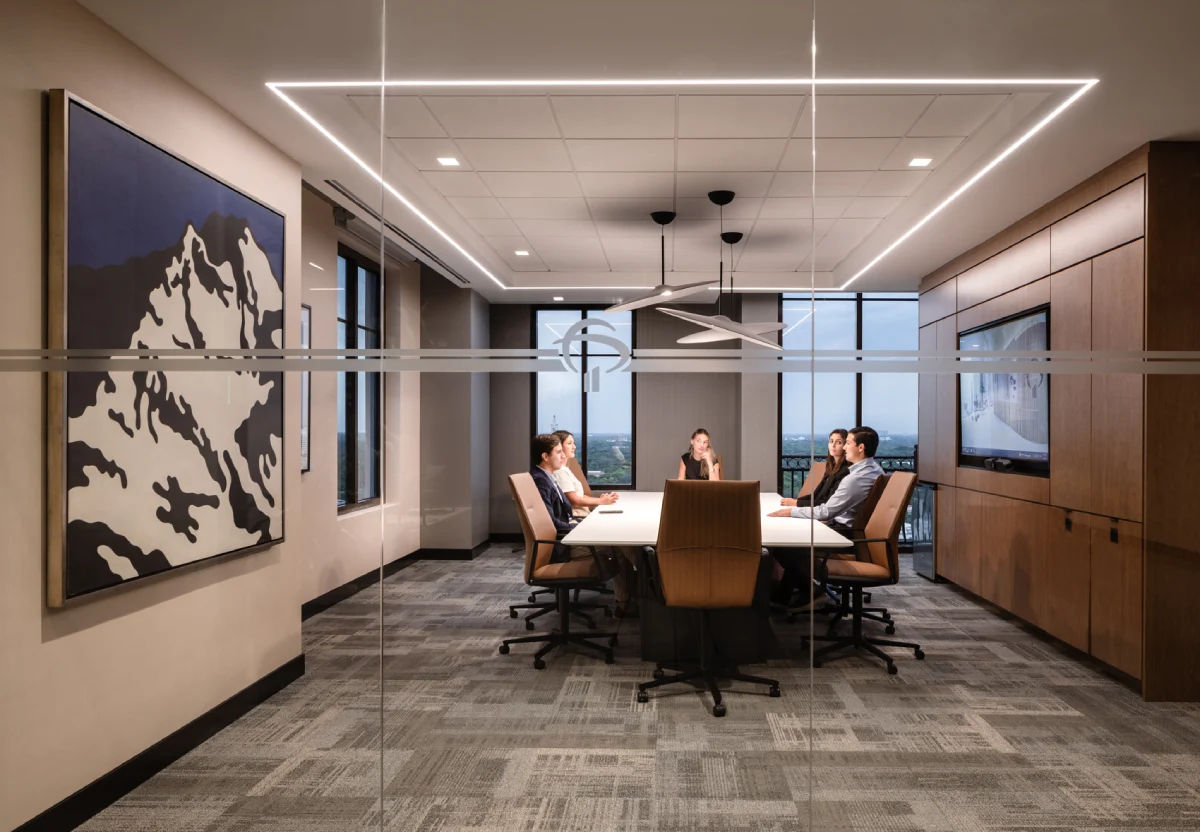
A commercial office fitout is the process of transforming a raw or base-build commercial space into a fully functioning, finished workplace. A complete fitout includes space planning and design, permitting, construction of partitions and specialist rooms, mechanical and electrical coordination, furniture and fixture installation, IT and AV infrastructure, and final commissioning.
The reason this definition matters is that many companies calling themselves fitout contractors only provide a portion of this stack. Some do design but not construction management. Some manage construction but not permitting. Some handle furniture but not the built environment. Understanding which services are genuinely integrated versus which are subcontracted to parties the firm has never worked with before is one of the most important questions to ask in any evaluation.
Timeline Questions: What to Ask Before You Believe Any Schedule
The Lease Commencement Problem
The most common driver of fitout stress in Florida commercial projects is the lease commencement deadline. When a business signs a new lease in Miami's Brickell financial district, Orlando's downtown creative quarter, or Tampa's Channelside, the lease clock starts ticking whether the office is ready or not. Fitout delays in this context do not just cause inconvenience; they generate costs in temporary arrangements, delayed team consolidations, and sometimes contractual penalties with landlords.
Questions to Ask About Timeline
Before accepting any fitout timeline, ask the company to break it into phases and justify each estimate independently. A credible fitout company should be able to tell you: how long permitting typically takes in your specific county, what the current lead time is for your furniture and fixtures, what the critical path dependencies are between trades, and what their contingency plan is if a permit gets delayed or a material delivery slips.
| Fitout Phase | Typical Duration | Key Risk Factor |
|---|---|---|
| Space planning and design finalization | 3–5 weeks | Client revision cycles and approval delays |
| Permit submission and approval | 3–6 weeks (Florida varies by county) | Incomplete documentation on first submission |
| Demolition and rough-in | 2–4 weeks | Discovery of unforeseen conditions |
| Partitions, ceiling, and finishes | 4–6 weeks | Material lead times and trade sequencing |
| Furniture and technology installation | 1–2 weeks | Procurement delays and delivery scheduling |
| Punch list and commissioning | 1–2 weeks | Subcontractor availability for defects |
AI Spaces Advantage
AI Spaces builds milestone-based fitout schedules with explicit phase durations, county-specific permitting lead times, and procurement buffers factored into the baseline timeline. Clients in Miami, Orlando, and Tampa receive a credible schedule, not an optimistic one.
Permitting: Why It Breaks Most Fitout Timelines
The Florida Permitting Reality
Commercial fitout permitting in Florida is more complex than in many other markets. Miami-Dade requires coordination across building, fire, and sometimes zoning departments depending on the use. Orange County and Hillsborough County each have their own submission requirements and review timelines. A fitout company without deep local permitting experience routinely underestimates this phase, and the client pays for that underestimation in delayed occupancy.
What to Look for in a Fitout Company's Permitting Process
Ask directly: Do you handle permitting in-house or do you outsource it? Do you have existing relationships with plan reviewers in this jurisdiction? What is your first-submission approval rate? How do you handle RFIs from plan review? A company that answers these questions with specificity and confidence has the process. One that deflects to "it depends" without detail probably does not.
AI Spaces Advantage
AI Spaces manages commercial fitout permitting as an internal competency across Florida markets. With established relationships in Miami-Dade, Broward, Orange, and Hillsborough Counties, the team submits complete, correct documentation the first time, minimizing review cycles and protecting the occupancy timeline.
Budgeting: How to Know If a Fitout Quote Is Real
The Anatomy of a Reliable Fitout Budget
A reliable commercial fitout budget has five components: a base construction cost with fully itemized scope, a furniture and fixtures allowance referenced to specified products, a technology and AV infrastructure budget, explicit permit and inspection fees, and a contingency allocation of five to ten percent for unforeseen conditions. A quote missing any of these components is incomplete, and will grow.
The Change Order Trap
Change orders are the primary mechanism by which fitout budgets grow after contract signing. They arise when the original scope was vague, when design decisions were deferred to construction phase, or when site conditions revealed during demolition were not anticipated. The best protection against change orders is a complete scope document and a clear change order authorization process that requires client approval above a defined threshold before any additional work proceeds.
AI Spaces Advantage
AI Spaces provides fully itemized fitout budgets with explicit contingency allocations and a documented change order process. Every change above the agreed threshold requires written client approval before work proceeds, protecting the budget at every stage.
Workspace Functionality: Design That Serves the Business
The most overlooked dimension of commercial fitout evaluation is whether the design actually reflects how the business operates. Many fitout companies produce layouts that look professional without investigating the organization's work patterns, collaboration requirements, acoustic needs, or technology dependencies.
A fitout that works aesthetically but fails operationally, too few meeting rooms for the actual meeting culture, open plan for a team that needs focus work, insufficient server room capacity for the IT infrastructure, creates costs in productivity and employee experience that dwarf the original fitout budget over a five-year lease.
AI Spaces Advantage
AI Spaces conducts a workplace functionality assessment before any design work begins, mapping organizational behavior to spatial requirements. The result is a fitout that reflects how your team actually works, not how a generic office template assumes they do.
Vendor Coordination: The Integration Question
Commercial fitout projects in Florida involve a significant number of vendors: architect, general contractor, electrical subcontractor, mechanical subcontractor, AV and technology integrator, furniture dealer, and often a landlord representative coordinating with base building systems. When a fitout company manages these relationships through the client, making the business owner the de facto project manager, the risk of miscommunication, delays, and blame-shifting between vendors is high.
The right question to ask any fitout company is: who is accountable for coordinating all vendors, all trades, and all inspections? If the answer involves the client making calls and managing multiple relationships, that is not a full-service fitout company. That is a design firm handing you a contractor list.
AI Spaces Advantage
AI Spaces operates as the single point of accountability for the entire fitout process. Design, permitting, construction, furniture, and technology coordination are managed under one integrated team, so the client never has to manage vendor relationships or resolve inter-party disputes.
Frequently Asked Questions
What does a commercial office fitout company actually do?
A full-service commercial office fitout company manages the end-to-end process of transforming a raw or base-build commercial space into a functioning workplace. This includes space planning and design, permitting, construction management, furniture and technology coordination, and final commissioning. Partial-service firms may only cover one or two of these areas.
How long does a commercial office fitout take in Florida?
A typical commercial fitout in Florida takes 14 to 22 weeks from design finalization to occupancy, depending on project scope and the complexity of permitting in the relevant county. Miami-Dade, Broward, and Orange County permitting timelines each have distinct characteristics that an experienced fitout company should be able to estimate accurately.
What should I look for in a commercial fitout company in Miami or Orlando?
- In-house permitting capability.
- Integrated project management that covers all vendor coordination.
- Milestone-based scheduling with realistic phase estimates.
- Fully itemized budgets with explicit contingency.
- References from fitout projects of comparable scope in your specific Florida market.
How can I avoid budget overruns in a commercial office fitout?
Require a fully itemized scope document before contract signing, ensure permit fees and contingency are explicitly included in the budget, establish a clear change order authorization process with client approval thresholds, and choose a company that manages all vendor coordination in-house rather than passing coordination responsibility to you.
Why do commercial fitout projects get delayed?
- Permitting bottlenecks caused by incomplete documentation.
- Material procurement delays not buffered into the timeline.
- Poor trade sequencing that creates dependency conflicts during construction.
- Vague scopes that generate design changes mid-build.
All of these are preventable with disciplined planning and local market experience.
Conclusion
A commercial office fitout is a significant investment that will shape how your team works for the duration of your lease. The company you hire determines whether that investment delivers on its promise.
Before signing any fitout contract in Florida, verify that the firm has in-house permitting expertise in your county, integrated vendor management across all trades, a milestone-based schedule with realistic phase estimates, and a fully itemized budget with explicit contingency. These are not premium features; they are the minimum requirements for a project that delivers without surprises.
AI Spaces serves commercial tenants across Miami, Orlando, Tampa, and South Florida with fully integrated fitout services, from workplace strategy and design through permitting, construction, and occupancy.
Explore commercial fitout services at aispaces.ai