Design
How to Avoid Paying Double Rent During an Office Renovation (Turnkey Workplaces)
Paying rent on both the old office and the new one at the same time is one of the most common, and most avoidable, costs in a Miami office renovation. It happens when construction on the new or renovated space runs long enough that the lease overlap window closes before the team can actually move in, and the company ends up covering two rent payments for weeks or months longer than planned. Turnkey workplace design services are built specifically to prevent that overlap.
Why the Overlap Happens
Rent overlap is almost always a coordination failure, not a construction failure. When a company hires an architect, a general contractor, and an interior designer separately, each party optimizes their own piece of the schedule, and the handoffs between them are where time disappears. The architect finishes drawings and waits for the contractor to mobilize. The contractor hits a permitting question that needs a design decision, and waits for the architect to respond. The interior designer's FF&E order depends on a construction milestone that has already slipped. None of these delays are dramatic on their own, but they stack, and the stack is what turns a planned two-week overlap into a two-month one.
The Turnkey Model
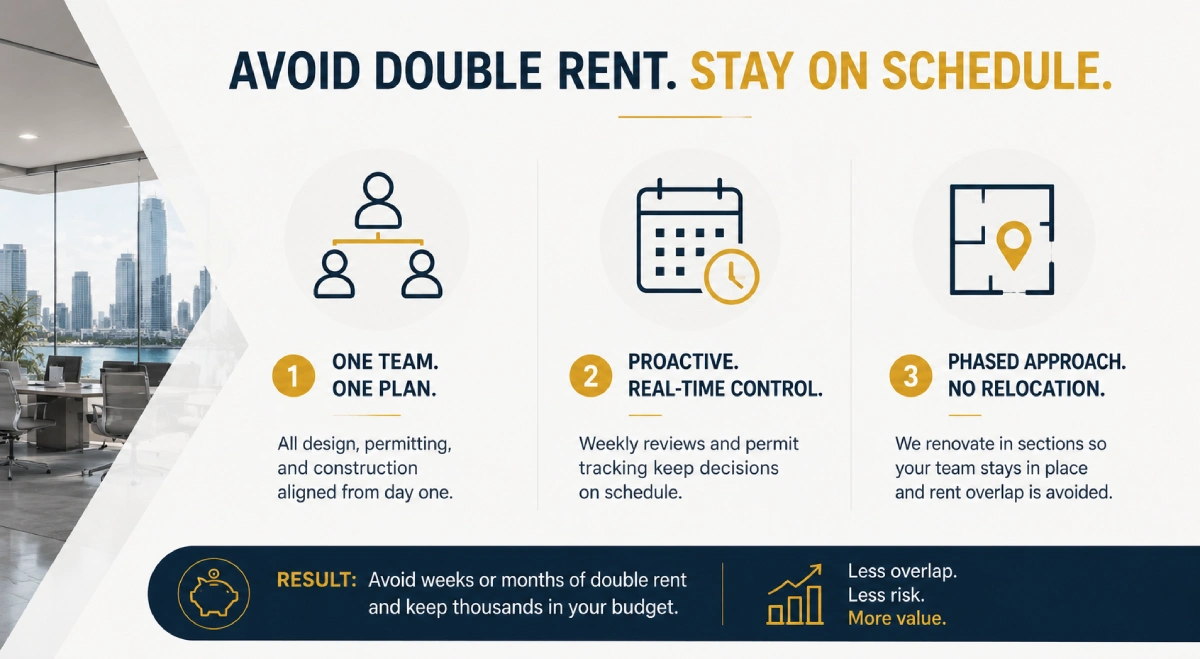
A turnkey engagement puts design, permitting, and construction under a single point of contact instead of three separate vendors coordinating through the client. That single point of contact is accountable for the whole schedule, not just their piece of it, which removes the handoff gaps where delays compound. In practice, that means:
- One team makes the call on schedule tradeoffs, instead of three vendors each waiting on someone else to decide.
- Permitting questions get resolved by the same team that produced the drawings, without a delay while a separate contractor tracks down the architect.
- FF&E ordering is scheduled against the actual construction timeline the same team is managing, not a projected timeline handed off from someone else.
Phased Renovation: Staying Operational During Construction
For Miami companies renovating a space they already occupy, whether in Brickell, Doral, or Coral Gables, a phased approach removes the overlap problem entirely by eliminating the need to relocate at all. Instead of vacating the whole floor and renovating it in one pass, AI Spaces renovates in sections, moving the team within the existing footprint as each section completes. The team never leaves the building, and there is no second lease to overlap with the first.
The Cost of Overlap, Side by Side
The math on avoided overlap is straightforward once it is laid out. A company paying $30,000 a month in combined old-and-new rent that avoids even two months of overlap through better coordination or a phased approach keeps $60,000 that would otherwise be spent on space the team was not fully using.
| Scenario | Overlap Period | Combined Monthly Rent | Total Overlap Cost |
|---|---|---|---|
| Uncoordinated (3 separate vendors) | 2 to 3 months | $30,000 | $60,000 to $90,000 |
| Turnkey, new space (single vendor) | 0 to 2 weeks | $30,000 | $0 to $15,000 |
| Phased renovation (no relocation) | None | N/A | $0 |
A company evaluating a renovation should ask any prospective design or construction partner for a realistic timeline estimate before committing, specifically so this comparison can be run against their own actual lease terms and monthly rent.
How Communication Is Structured to Prevent Slippage
Beyond consolidating vendors under one point of contact, the turnkey model relies on a specific communication cadence that most uncoordinated projects lack entirely. Weekly schedule reviews track every open decision against the date it needs to be closed by, not just the date it was originally requested, which surfaces a slipping decision while there is still time to recover the schedule rather than after the delay has already occurred.
For Brickell, Doral, and Coral Gables projects specifically, this cadence also tracks permitting status against the specific municipality's known review patterns, since Miami-Dade County, the City of Miami, and Coral Gables each move through commercial permit review on different timelines. A turnkey team tracking that variance from experience can flag a likely delay before it happens, rather than discovering it when a permit comes back with comments the client was not expecting.
Frequently Asked Questions
How do you avoid paying double rent during an office renovation?
The most reliable way is to use a single turnkey team managing design, permitting, and construction together, which removes the handoff delays that cause schedules to slip. A phased renovation of an existing space avoids the overlap entirely by eliminating the need to relocate.
What is a turnkey office build-out?
A turnkey build-out is a project delivery model where one firm is accountable for design, permitting, and construction as a single coordinated process, rather than the client managing separate vendors for each phase.
Can a phased office renovation happen without relocating the team?
Yes. AI Spaces renovates Miami offices in sections, moving employees within the existing footprint as each section is completed, so the team stays in the building throughout construction.
How much does rent overlap typically cost during a renovation?
It depends on monthly rent and how long the overlap runs, but uncoordinated projects with separate vendors commonly see two to three months of overlap, which at typical Miami commercial rents can mean $60,000 or more in avoidable cost.
Want a realistic renovation timeline before you commit to a lease overlap? AI Spaces provides Miami companies with a turnkey schedule estimate tied to their specific space. Visit aispaces.ai to request yours.