Design
Dynamic Zoning Strategies That Really Work in 2026

AI SPACES | WORKPLACE STRATEGY | APRIL 2026
The way companies use their offices has changed more in the last five years than in the previous fifty. Hybrid schedules, activity-based working, and the ongoing negotiation between employer and employee over where and how work gets done have fundamentally rewritten the brief for what a high-performing office must deliver. Yet, many corporate interiors are still organized around outdated assumptions; static floor plans designed for a workforce that came in every day, sat at assigned desks, and worked from nine to five.
Dynamic zoning is the architectural response to this reality. It organizes an office not around fixed headcount or departmental silos, but around the full range of activities knowledge work requires, allowing spaces to evolve as needs shift. Done well, it transforms an office from a place people go because they have to into an environment that actively earns their presence.
At AI Spaces, we have been designing dynamically zoned workplaces for corporate clients across Miami and Latin America through every phase of this transformation. The following examples show what the best-performing implementations actually look like in 2026; not as theory, but as practice.
Why Static Layouts Are Costing Companies Money
Before addressing dynamic zoning, it is worth being precise about the costs of static layouts. The financial case for rethinking office organization is concrete and measurable, yet often underutilized in workplace strategy conversations.
Most corporate offices built before 2020 were designed for 80–100% daily occupancy. Post-pandemic attendance patterns have settled in the 40–65% range on peak days. This means a significant portion of expensive, built-out, conditioned, and cleaned floor space sits empty not because employees are disengaged, but because the space was designed for a different model of work.
When a layout does not support actual activities, friction accumulates. Employees needing focus take their laptops elsewhere; teams requiring collaboration avoid the office on project-heavy days. The space fails the people it was built to serve, and those people vote with their feet.
Business impact: Organizations that redesign for dynamic zoning report average utilization increases of 30 - 40% without adding square footage. The same lease, used better, delivers meaningfully more value.
The Four Zones Every High-Performance Office Needs in 2026
.webp)
Dynamic zoning is a framework for ensuring every work mode has a physical home. Execution varies by organization, culture, and industry, but the logic remains consistent.
Zone 1: Deep Focus
This is the zone most hybrid offices get wrong. Focused work requires acoustic privacy, visual separation, and an environment signaling that concentration is expected. Enclosed or semi-enclosed workspaces like focus booths, library-style quiet zones, or phone-free concentration areas make up roughly 25–35% of the usable floor plate.
- Acoustic panels, ceiling baffles, and sound-absorbing surfaces achieving NC-30 or lower ambient noise.
- Warm, task-appropriate lighting at 300–500 lux to reduce eye fatigue.
- Visual separation from high-traffic paths; focus zones at perimeter or interior areas.
- Clear behavioral signaling through materiality and layout.
Zone 2: Collaborative Work
Collaboration drives office attendance. Real collaboration in 2026 includes spontaneous conversations, small team sessions, and flexible week-long project spaces. Effective zones support 2–6 people with reconfigurable furniture, writeable surfaces, and integrated A/V. Recommended ratio: one formal boardroom for every 3–4 informal collaboration spaces.
Zone 3: Social and Recharge
The social zone is commercially underestimated. Anchored by a café, kitchen, or lounge, it drives office attendance and facilitates unscripted interactions that remote work cannot replicate. A well-designed social zone increases employee satisfaction with minimal investment.
Zone 4: Hybrid-Ready Meeting Infrastructure
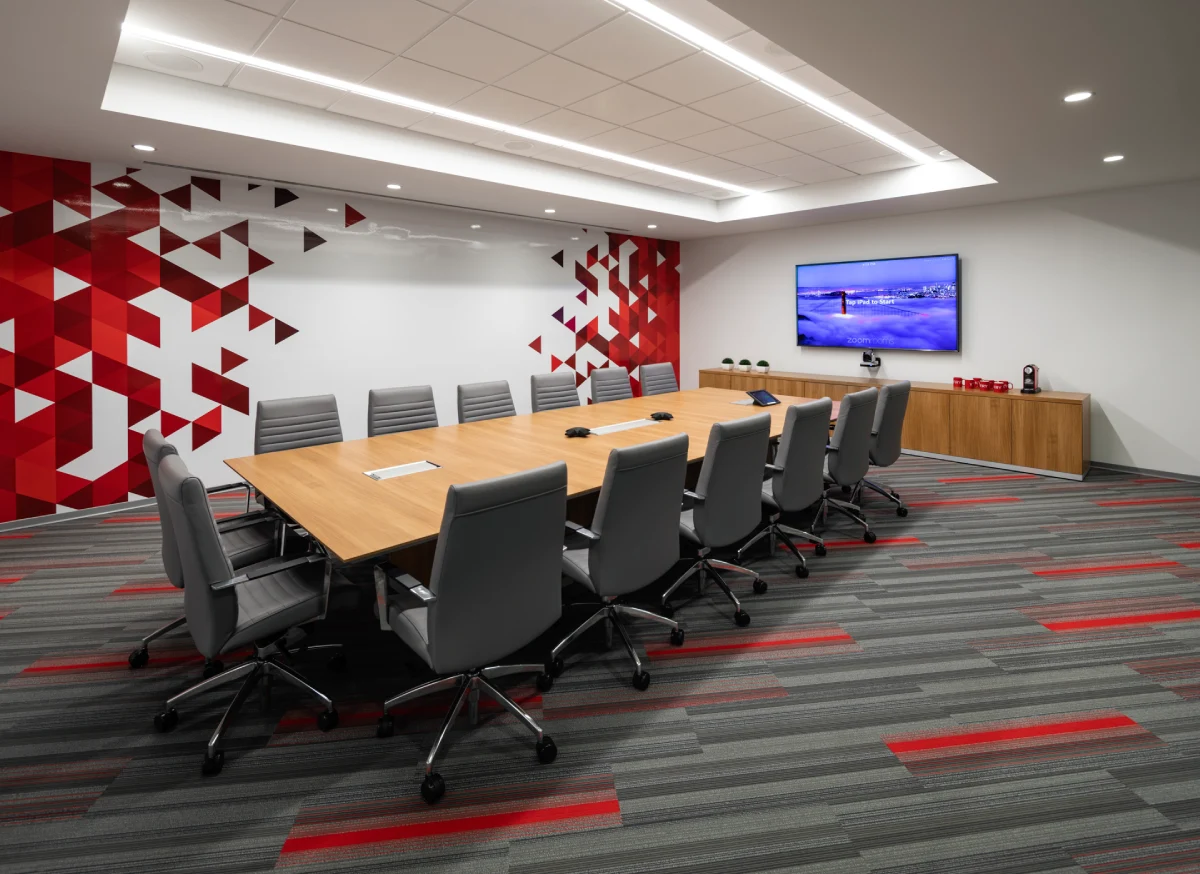
Every meeting space must support hybrid audiences seamlessly. Camera placement, audio systems, and displays must enable equal participation. A consistent interface eliminates technical friction, reducing the 'hybrid meeting tax' and improving productivity.
Acoustic Management: The Non-Negotiable Foundation
Noise is the leading driver of workplace dissatisfaction. Effective dynamic zoning requires acoustic management at three levels: macro (floor plan separation), meso (partition height, ceiling treatment, materials), and micro (furniture and soft furnishings). All levels must work together to create a functional office.
Structural Adaptability: Building for the Office You Will Need
The most sophisticated dynamic zoning designs anticipate future work patterns. Structural adaptability includes flexible partitions, distributed power and data, and layered furniture strategies to accommodate organizational growth, contraction, or evolving work modes.
Workspace Fluidity: Moving Beyond the Assigned Desk
Workspace fluidity allows employees to move seamlessly between focus, collaboration, and social zones. Legible floor plans, simple booking systems, and a culture of permission maximize utilization and adoption, ensuring the office delivers on its intended value.
The Business Case in Summary
Dynamic zoning is a response to a permanent shift in knowledge work. Offices designed as strategic assets outperform static layouts on talent attraction, retention, collaboration quality, and real estate efficiency. Organizations adopting dynamic zoning report fuller, quieter, more productive, and culturally coherent spaces.
Frequently Asked Questions
How does Miami compare nationally in demand for legal office space?
Miami ranks 3rd among U.S. metro areas for lawyer demand, behind only Washington D.C. and Tallahassee, reinforcing the need for zoning that supports fast-growing teams. Source: The Florida Bar / ABA location-quotient analysis
Do the professionals designing law firm zoning need to be licensed in Florida?
Yes — Florida has about 2,500 registered interior designers under DBPR's Board of Architecture and Interior Design, the body that regulates zoning-related buildouts statewide. Source: Florida DBPR, Board of Architecture and Interior Design
Can Florida law firms afford to invest in better-zoned, higher-end office space?
The average Florida lawyer's annual salary climbed 19.2% from 2021 to 2023, the biggest two-year jump this century, reaching $176,470 — income growth that supports investment in upgraded, well-zoned office space. Source: The Florida Bar, citing ABA 2024 Profile of the Legal Profession
AI Spaces LLC | aispaces.ai | Interior Architecture & Design for Corporations

More Articles to Keep Designing Your Workspace
Guides, inspiration and workspace ideas