FeaturedBlog
A Step-by-Step Guide to How Top-Tier Law Firms Guarantee Sophistication in Their Spaces

A law firm's physical environment is not a backdrop. It is a statement. Before a client hears a single argument, reviews a single contract, or receives a single piece of counsel, the space has already communicated something about the firm's caliber, its values, and the quality of judgment it exercises. In the legal profession, where trust is the currency and reputation is the product, that communication cannot be left to chance.
The most elite law firms in the world understand this intuitively. Their offices are not luxurious for the sake of luxury, they are designed with precision to project authority, competence, and discretion. Every material selection, every spatial proportion, every lighting decision serves the same strategic purpose: to confirm, in the mind of every client who walks through the door, that they have chosen correctly.
What separates those firms from the rest is not budget alone. It is a clear, disciplined approach to design; a set of principles applied consistently from the lobby to the partner suite. At AI Spaces, we have designed legal environments across Miami and Latin America for firms at every stage of their growth. This is the step-by-step process that the best of them follow.
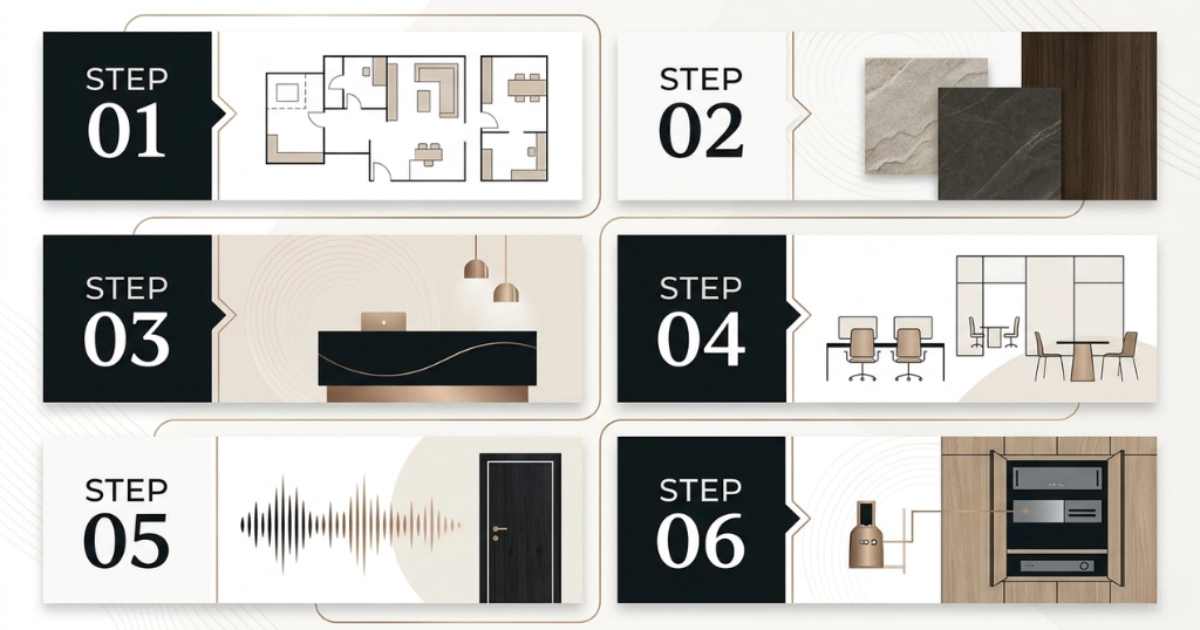
The first and most consequential decision in any law firm design project is not about materials or color, it is about spatial hierarchy. Who works where, who moves through which spaces, and what that arrangement communicates about the firm's structure and culture.
Law firms operate within clearly defined hierarchies: partners, associates, paralegals, support staff, and clients each have distinct relationships to the space. A design that fails to reflect those relationships, or worse, one that undermines them through spatial ambiguity, creates friction that is felt every day by everyone in the firm.
Defining spatial hierarchy means making deliberate decisions about:
- Partner suite placement, typically perimeter offices with natural light, signaling seniority and the privilege of the view
- Associate workspace organization, whether individual offices, shared offices, or open bullpen, the arrangement should reflect the firm's culture on collaboration and advancement
- Client-facing zones, reception, meeting rooms, and hospitality areas that clients inhabit should be spatially separated from internal working areas, creating a clear front-of-house and back-of-house logic
- Circulation pathways, how clients move from reception to meeting rooms should never require them to pass through working areas; privacy and confidentiality begin with the floor plan
Elite law firm design is distinguished above all by its material discipline. The instinct in many design briefs is to reach for what is current, the finish that is appearing in the best offices this year, the stone that was featured in a recent architectural publication. Top-tier legal environments resist this instinct deliberately.
The reason is longevity. A law firm that redesigns its offices every five years because the finishes have dated is communicating something about its relationship to permanence that undermines its brand. The materials in a great legal interior should feel as authoritative in fifteen years as they do on opening day.
Sophistication in legal design is not about what is fashionable, it is about what is enduring: materials and proportions that communicate permanence and judgment.
The material palette that consistently achieves this standard is built around a core tension: deep darks against snow whites and warm neutrals. Specifically:
- Deep blacks and near-blacks, blackened steel, dark-stained oak, nero marquina marble, used for architectural elements, millwork, and hardware that anchor the space and communicate gravity
- Snow whites and warm off-whites, Venetian plaster, honed limestone, white oak with a light stain, used for primary surfaces that create contrast and prevent the palette from becoming oppressive
- Warm metallic accents, brushed brass, aged bronze, or unlacquered metals, used with extreme restraint as hardware, lighting fixtures, and detail elements that add warmth without introducing color
- Natural stone, book-matched marble or travertine for reception desks, conference tables, and key architectural surfaces, the most legible signal of investment and permanence available to a law firm interior
What this palette deliberately excludes is as important as what it includes: saturated color, decorative pattern, trendy materials with a short design half-life, and anything that reads as residential rather than institutional. The goal is an environment that feels like it has always been this way, and always will be.
The reception area of a law firm is the highest-stakes square footage in the building. It is where first impressions are formed, where client anxiety is either addressed or amplified, and where the firm's identity is expressed in its most concentrated form. It deserves, and in the best firms receives, a disproportionate share of the design investment.
The reception moment is composed of several overlapping experiences that must all work simultaneously:
- Arrival orientation, the guest should understand immediately where to go, where to sit, and that they are expected; confusion on arrival is an early erosion of confidence
- Scale and proportion, the reception ceiling height, desk scale, and furniture selection should communicate substance without intimidation; the best legal receptions feel authoritative but not alienating
- Material density, this is the area where the richest materials in the palette are concentrated; a reception desk in book-matched marble with blackened steel detail communicates investment in a way that no signage can
- Lighting calibration, reception lighting should be warm and directional, creating a sense of welcome while avoiding the clinical brightness of a corporate lobby; pendant fixtures at human scale are almost always preferable to recessed downlighting alone
- Brand expression, the firm's name, typically in dimensional letters in a refined metal finish, should be the single focal point of the back wall; nothing else competes with it
The waiting experience matters as much as the first impression. Seating that is genuinely comfortable, not merely expensive-looking. Reading material that reflects the firm's areas of practice and intellectual character. A sight line that offers something considered, a piece of art, a material feature, a view, rather than a blank wall or a busy workstation.
One of the central design challenges in elite legal interiors is the tension between hierarchy and modernity. Law firms are among the most hierarchical organizations in professional services, and that hierarchy is real, functional, and important to preserve. At the same time, the best firms understand that an office that looks like it was designed in 1995 sends a signal about organizational culture that talented associates are increasingly unwilling to accept.
The resolution of this tension is not to abandon hierarchy, it is to express it through spatial quality rather than spatial exclusivity. The difference matters.
Spatial exclusivity means that partners get windows and associates get interior desks, partners get large offices and associates share small ones. This approach preserves hierarchy but at a significant cost to associate satisfaction and retention.
Spatial quality means that every workspace in the firm, from the managing partner's suite to the associate bullpen, is genuinely well-designed: well-lit, acoustically managed, ergonomically considered, and finished with materials appropriate to its purpose. Partners receive more space and more privacy, as hierarchy demands. But no one in the firm occupies a space that feels like an afterthought.
The modern expressions of this principle that we see in the highest-performing legal interiors:
- Partner offices designed as genuine architectural moments, not just larger versions of associate offices, but spaces with considered proportion, bespoke millwork, and finishes that signal the milestone of partnership
- Associate workspaces with acoustic management, ergonomic furniture, and access to natural light, the details that make a workspace genuinely functional rather than merely present
- Shared amenity spaces, a library, a coffee bar, a rooftop terrace where the geography allows, that serve every level of the firm and create moments of cultural connection across hierarchy
- Meeting rooms at multiple scales, from one-on-one consultation rooms to full-firm boardrooms, each finished to the same standard, each equipped for hybrid work
Confidentiality is not just a professional obligation for law firms, it is a client expectation that shapes how clients feel about the entire engagement. A client who can hear another client's conversation through a partition wall, or who suspects that their own conversation can be overheard, has had their trust in the firm structurally damaged, regardless of the quality of the legal counsel they receive.
Acoustic privacy in a law firm is therefore not a comfort feature. It is a professional requirement with direct implications for client retention and liability. Designing for it means:
- Sound masking systems in open areas and corridors, these introduce a low-level broadband sound that reduces speech intelligibility without adding perceived noise
- Full-height, acoustically rated partitions for all client-facing meeting rooms and partner offices, glass partitions that look elegant but transmit sound are not appropriate for confidential conversations
- Door and hardware specifications that achieve STC-45 or higher for meeting rooms, the difference between a solid-core door with an acoustic seal and a standard door is measurable in decibels and meaningful in practice
- HVAC duct design that prevents speech transmission between adjacent rooms, a commonly overlooked vector for acoustic failure that is extremely difficult to address after construction
Client insight: In post-occupancy surveys across our legal design projects, acoustic performance consistently ranks as the highest-impact dimension of the client experience, above aesthetics, above technology, and above comfort.
The technology requirements of a modern law firm, video conferencing in every meeting room, secure document management, integrated presentation systems, are significant and non-negotiable. The design challenge is to incorporate them seamlessly enough that they do not undermine the crafted, material-rich aesthetic that elite legal interiors are built around.
The principle that guides this integration is concealment without compromise. Every piece of technology should perform flawlessly and be discoverable when needed. None of it should be visible when not in use.
In practice, this means:
- Cable management integrated into millwork rather than surface-mounted, a conference table with visible cable management trays immediately signals that the technology was added after the design, not designed in from the beginning
- Screens that recess flush into millwork or behind motorized panels when not in use, a boardroom where the screen disappears when the meeting ends is a boardroom that reads as designed rather than equipped
- Control interfaces in consistent, considered locations, flush-mounted panels in the same finish as the surrounding millwork, not afterthought plastic boxes mounted at eye level
- Lighting control systems that allow meeting rooms to transition from presentation mode to discussion mode without a user needing to find a switch
The Standard Is Set by the Details
What distinguishes a truly elite law firm interior from an expensive but generic one is not the magnitude of the investment, it is the quality of the decisions made at every level of resolution. The proportion of the reception desk. The reveal between the wall panel and the floor. The weight of the door handle. The temperature of the light in the conference room at four o'clock in the afternoon.
These details are invisible when they are right. They register as a cumulative impression, the sense that this firm exercises exceptional judgment in everything it does, including the design of the space in which it works. That impression, formed in the first ninety seconds of a client's arrival and reinforced at every subsequent visit, is one of the most durable competitive advantages a law firm can build.
At AI Spaces, we design legal environments that create and sustain that impression, from the spatial hierarchy of the floor plan to the finish on the final door handle. Because in the legal profession, sophistication is not a style choice. It is a professional obligation.
See how we've transformed law firm environments across Miami and Latin America,book a strategy call with AI Spaces at aispaces.ai
AI Spaces LLC | aispaces.ai | Interior Architecture & Design for Corporations