Design
How to Choose a Restaurant Renovation Company Without Overpaying

Cover image of the Marriott project by Santiago Muñoz.
Restaurant renovation is one of the highest-stakes decisions a Florida operator can make. Whether you are refreshing a dining room in Miami's competitive Design District, modernizing a Tampa waterfront space, updating an Orlando tourist-corridor location, or repositioning a South Florida neighborhood concept, the renovation company you hire will determine whether the project comes in on budget, on schedule, and at the quality level your brand requires.
The problem is that most restaurant renovation companies look credible in the sales process. The real differences, in planning quality, cost transparency, timeline reliability, and execution discipline, only become clear after the contract is signed. This guide is designed to help you ask the right questions before that happens.
Why Restaurant Renovations Go Over Budget
The most common causes of restaurant renovation cost overruns are: vague initial scopes that expand mid-project, fragmented contractor relationships where no one is accountable for total cost, poor planning that generates expensive late-stage design changes, and weak project management that fails to catch budget drift early.
Understanding these root causes changes how you evaluate a renovation company. Instead of asking "how much will this cost?", you start asking "how do you prevent costs from growing after we agree on a number?" That is the question that separates firms with disciplined processes from those without.
1. Scope Definition: The Most Important Document in Any Renovation
Where Restaurants Get Trapped
A vague scope of work is the primary driver of change orders in restaurant renovation projects. When a contract says "kitchen renovation" without specifying fixture counts, finish specifications, equipment types, ventilation standards, and coordination requirements with the landlord, every subsequent decision becomes a potential change order. In a busy Florida restaurant market, vague scopes routinely add 15 to 30 percent to original project budgets.
What to Look For
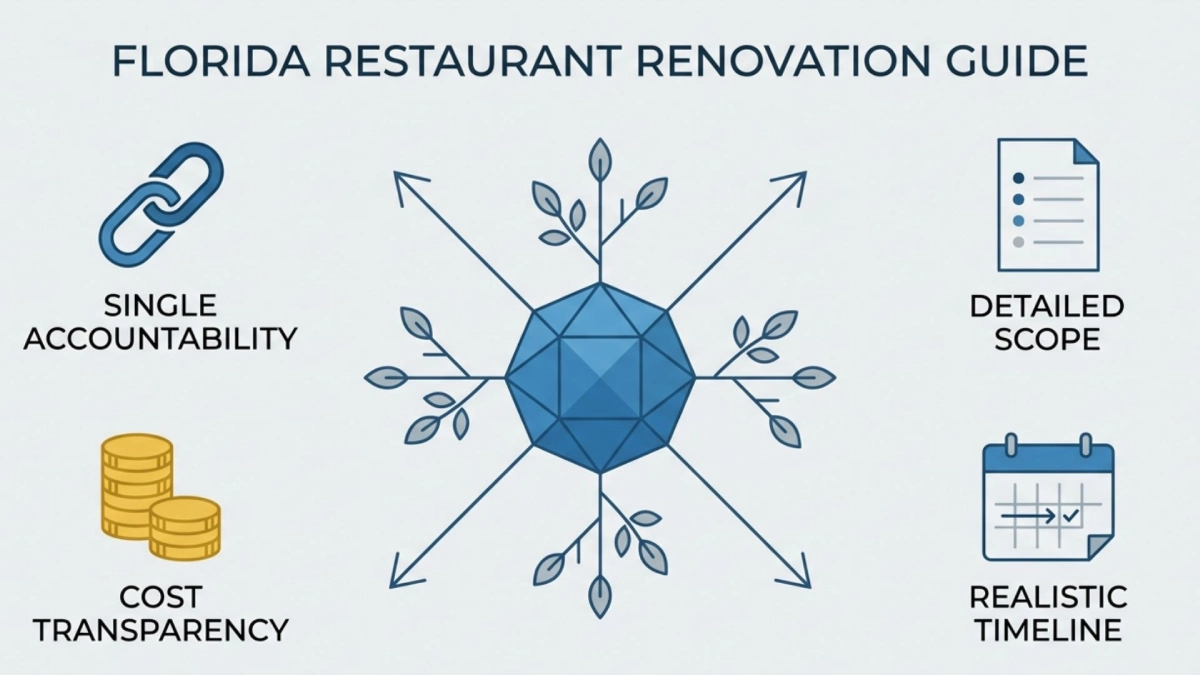
A strong renovation company will produce a detailed scope document before pricing begins, one that specifies every material, every system, every finish, and every coordination requirement. This document is the foundation of the contract and the budget. If a firm is resistant to this level of detail upfront, treat it as a red flag.
Why AI Spaces Is Different
AI Spaces builds fully itemized scope documents before presenting any cost estimate. Every material, finish, system, and coordination requirement is specified in writing before the project begins, eliminating the ambiguity that generates costly change orders downstream.
2. How to Compare Renovation Quotes Without Getting Misled
The Low-Bid Problem
The lowest renovation quote in Florida almost never represents the best value. Low bids typically rely on one or more of the following: using cheaper substitution materials that were not specified, excluding permit fees and inspection costs, omitting allowances for unforeseen conditions, and planning for a faster timeline than is realistically achievable. The gap between the low bid and the final invoice is where restaurant owners lose money.
How to Compare Quotes Properly
| Evaluation Criterion | Red Flag | Good Sign |
|---|---|---|
| Scope Completeness | Broad categories, no line items | Fully itemized with material specs |
| Permit Costs | Not included or vaguely estimated | Explicitly included with contingency |
| Unforeseen Conditions | No mention or zero allowance | Explicit contingency budget (5–10%) |
| Timeline | Vague or unusually fast | Milestone-based with buffer logic |
| Change Order Process | Not addressed in proposal | Documented process with approval thresholds |
| Contractor Coordination | Client manages subcontractors | Firm manages all vendor relationships |
Why AI Spaces Is Different
AI Spaces provides fully transparent, line-itemized quotes with explicit inclusion of permit costs, unforeseen condition contingencies, and clearly documented change order processes. There are no hidden line items and no surprises at invoice.
3. Red Flags to Watch For When Evaluating Renovation Companies
Certain patterns in the sales and scoping process reliably predict execution problems later. Watch for these warning signs when evaluating any restaurant renovation contractor in Florida:
- Unwillingness to provide a detailed written scope before contract signing.
- No mention of permitting coordination in their proposal, this usually means the client manages it.
- References from projects in different industries that do not reflect restaurant-specific complexity.
- Payment schedules that front-load cash to the contractor without milestone-based release triggers.
- No single point of contact for the project, multiple people who "handle different parts."
- Inability to explain their subcontractor selection and management process.
- Portfolios with finished photography only, no discussion of how projects were managed or resolved.
Why AI Spaces Is Different
AI Spaces operates as a fully integrated project delivery firm, with in-house project management, established subcontractor networks, and milestone-based payment structures that protect the client at every stage of delivery.
4. Timeline Evaluation: How to Tell If a Schedule Is Realistic
How Timeline Estimates Go Wrong
Renovation timelines in Florida are frequently underestimated by firms eager to win projects. The most common timing failures involve permitting, particularly in Miami-Dade, Broward, and Orange Counties where commercial renovation permits require multiple agency approvals. A firm that quotes 8 weeks for a full restaurant renovation without accounting for 3 to 5 weeks of permitting lead time is giving you a number, not a plan.
What a Realistic Timeline Looks Like
Ask any renovation company to break their timeline into specific phases: design finalization, permit submission, permit approval, demolition, rough-in work, finish installation, fixture and equipment installation, punch list, and final inspection. Each phase should have an estimated duration and a clear dependency relationship with the phases before and after it. If a company cannot produce this level of scheduling detail, their timeline estimate is not credible.
Why AI Spaces Is Different
AI Spaces delivers milestone-based project schedules with explicit phase durations, dependency maps, and permitting lead time built into the baseline. Clients always know what the critical path is and where the project stands relative to the target occupancy date.
5. What You Should Actually Pay For, and What Is Often Overpriced
Understanding renovation cost structure helps you evaluate proposals more critically. The following framework distinguishes between areas where spending more directly improves outcomes versus areas where higher costs often reflect inefficiency rather than quality:
| Cost Area | Worth Paying For | Often Overpriced |
|---|---|---|
| Project Management | Dedicated PM with real authority over vendors | Administrative overhead with no real coordination |
| Permitting | Experienced expediter with local relationships | Generic permit runner who treats all markets the same |
| Materials | Specified materials with documented alternatives | Premium markups on unspecified "designer" options |
| Contractor Network | Pre-vetted subs with known quality and pricing | Open-market bidding passed on as "competitive pricing" |
| Design Integration | Designer embedded in construction coordination | Design and build treated as separate silos |
Why AI Spaces Is Different
AI Spaces integrates design and construction management under one team, with pre-established subcontractor relationships and transparent material specifications. Clients pay for coordination and quality, not for overhead they cannot see.
Frequently Asked Questions
How do I choose a restaurant renovation company without overpaying?
Start with scope clarity, require a fully itemized scope document before signing anything. Compare proposals on equal terms by ensuring all quotes include permits, contingencies, and contractor coordination. Ask for milestone-based timelines and documented change order processes. The goal is to find a firm whose process eliminates cost uncertainty, not just a firm with the lowest initial number.
What are the most common hidden costs in restaurant renovation quotes?
- Permitting fees not included in the base quote.
- Unforeseen conditions discovered during demolition.
- Change orders generated by vague initial scopes.
- Material substitution costs when specified products have long lead times.
- Coordination fees for managing multiple subcontractors.
How long does a restaurant renovation take in Florida?
A typical full restaurant renovation in Florida takes 12 to 20 weeks from design finalization to occupancy. This includes 3 to 6 weeks for permitting depending on jurisdiction, 4 to 8 weeks for construction, and 1 to 2 weeks for punch list and final inspections. Firms quoting shorter timelines without a phased schedule should be asked to substantiate their estimate.
What questions should I ask a restaurant renovation contractor before hiring them?
- Do you handle permitting in-house?
- Can you provide a milestone-based schedule with phase durations?
- Who will be my single point of contact throughout the project?
- What is your change order approval process?
- Can you provide references from restaurant renovation projects of similar scope completed in this Florida market?
Why do restaurant renovation projects go over budget?
The most common causes are vague scope documents that create change order opportunities, permitting delays not accounted for in the original timeline, poor subcontractor coordination that generates rework, and inadequate contingency budgeting for the unforeseen conditions that are almost always present in commercial renovation work.
Conclusion
Choosing a restaurant renovation company in Florida is not about finding the cheapest bid or the most impressive portfolio. It is about finding a firm with a disciplined process that protects you from the cost overruns, timeline failures, and execution gaps that derail most renovation projects.
The right firm will produce a complete scope before pricing, manage permitting as an internal competency, deliver milestone-based scheduling, and maintain transparent cost tracking throughout the project. These are not premium features; they are minimum requirements for a project that delivers on its promises.
AI Spaces works with restaurant owners across Miami, Tampa, Orlando, and South Florida to deliver renovation projects with the integration, transparency, and execution discipline that the Florida dining market demands.
Learn more at aispaces.ai