Design
Modern Law Office Design Inspiration: Minimalist, Art Deco, and Tropical Luxury Trends for 2026

Modern law office design has entered a new era. The mahogany-and-dark-leather aesthetic that defined legal workplaces for decades is giving way to something more considered: spaces where architectural rigor, material sophistication, and brand identity converge to create offices that are both professionally authoritative and visually compelling.
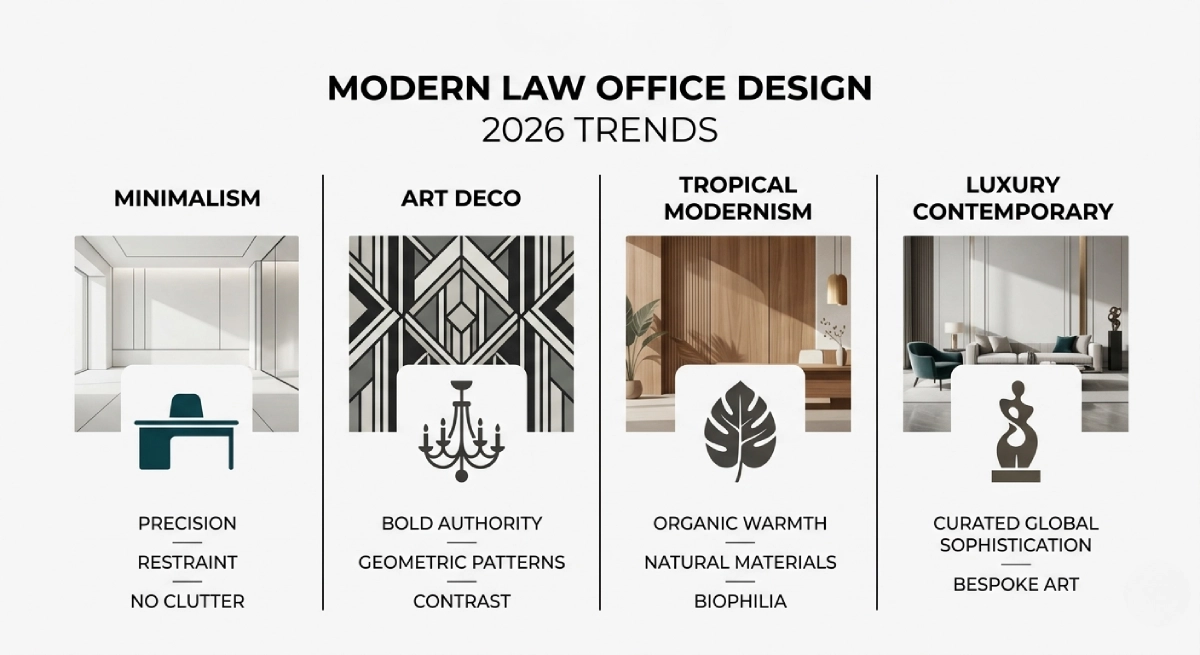
For 2026, four design languages are dominating the legal workspace conversation: minimalism, Art Deco revival, tropical modernism, and contemporary luxury. Each offers a distinct approach to materiality, light, and atmosphere, and each can be calibrated to the specific brand identity and client experience goals of a law firm.
What Defines Modern Law Office Design in 2026?
Modern law office design in 2026 is characterized by intentional materiality, architectural clarity, and a shift away from traditional prestige markers toward design languages that communicate sophistication, restraint, and forward-thinking professionalism.
The shift is not purely aesthetic. It reflects a change in how law firms want to be perceived: less institutional, more elite; less intimidating, more authoritative.
Trend 1: Minimalist Law Office Design
The Architecture of Clarity
The minimalist law office trend draws from Scandinavian and Japanese design philosophy: the idea that restraint is itself a form of luxury. In legal environments, minimalism carries particular resonance, communicating precision, control, and the absence of distraction.
Defining characteristics of minimalist law office interiors:
- Monochromatic or tonal palettes: warm whites, warm greys, natural stone, and muted wood tones
- Clean geometry: flush joinery, hidden hardware, seamless transitions between surfaces
- Edited furniture: fewer pieces, higher quality, more spatial breathing room
- Controlled lighting: recessed fixtures, indirect cove lighting, natural light maximized through unobstructed glazing
- Absence of visual clutter: document storage concealed, technology integrated into surfaces
What makes minimalism powerful in a legal context is its implicit communication: nothing here is accidental; everything is considered. For clients navigating complex legal matters, this environment projects exactly the right message.
Material palette for minimalist law offices: Honed Calacatta marble, bleached oak, brushed nickel, linen upholstery, frosted acoustic glass.
Trend 2: Art Deco Law Office Design
Miami Modernism Meets Legal Authority
Art Deco is having a meaningful revival in commercial interiors, and nowhere more powerfully than in cities like Miami, where the architectural vocabulary of the 1920s and 1930s is embedded in the urban landscape itself.
For law firms with offices in Miami, or firms that want to project established authority with visual boldness, Art Deco-influenced design offers a distinctive alternative to contemporary minimalism.
Core elements of Art Deco law office design:
- Bold geometric patterns: chevrons, sunbursts, and stepped forms in flooring, millwork, and ceiling details
- High-contrast material combinations: black marble with brass, ebony with gold leaf, lacquered surfaces with chrome
- Verticality: tall ceilings, floor-to-ceiling cabinetry, elongated door proportions that emphasize grandeur
- Rich color accents: deep navy, forest green, burgundy, or emerald used strategically against neutral backgrounds
- Decorative lighting fixtures: visible chandeliers, sconces, and pendants as architectural objects, not just light sources
Art Deco law office design ideas that work in 2026:
The key to contemporary Art Deco isn't historical reproduction: it's selective reference. A brass-inlaid reception desk in an otherwise clean space. A geometric terrazzo floor under modern furnishings. Sunburst paneling in a boardroom with otherwise restrained detailing.
Trend 3: Tropical Modernism
Warmth, Nature, and Organic Authority
Tropical modernism is emerging as one of the most sophisticated directions in contemporary office design, particularly in Miami, Latin America, and Southeast Asian legal markets. It merges the warmth of natural materials with the precision of modern architecture, creating spaces that feel both organic and intentional.
Why tropical modernism resonates for law firms:
It humanizes authority. Rather than projecting cold institutional power, tropical modern law offices communicate approachability without sacrificing professionalism: a particularly effective brand positioning for firms serving entrepreneurial, creative, or international clients.
Defining elements of tropical modern office design in Miami and comparable markets:
- Natural materials as primary surface language: warm teak, rattan, volcanic stone, terracotta
- Indoor-outdoor spatial logic: where possible, visual or physical connection to exterior greenery or sky
- Layered lighting: warm ambient light combined with natural light, avoiding the cold fluorescent register of traditional legal offices
- Integrated biophilia: not decorative plant placement, but structural greenery; moss walls, interior planting as room dividers, living walls in reception areas
- Handcrafted and tactile finishes: woven textiles, handmade ceramic tiles, raw concrete with visible texture
Materiality in tropical modern law offices: Smoked oak, honed basalt, unlacquered brass, handwoven rattan panels, warm concrete, textured linen, and matte terracotta.
Trend 4: Luxury Contemporary Legal Office Aesthetics
The New Language of Legal Prestige
Contemporary luxury in law office design moves beyond the traditional markers of prestige (dark wood paneling, oil paintings, leather-bound books) and toward a more curated, art-forward aesthetic that signals global sophistication.
Core characteristics of luxury contemporary legal offices:
- Bespoke millwork and custom furniture: nothing off-the-shelf; every piece designed or selected for the specific space
- Art as spatial anchor: original works or high-quality commissions that communicate cultural investment and intellectual seriousness
- Sophisticated textile programming: custom rugs, acoustic fabric panels, window treatments designed as design objects
- Technology-integrated surfaces: motorized glass partitions, concealed AV systems, integrated lighting control
- Material depth: layering multiple finishes (stone, wood, metal, textile) in a single space to create visual richness without clutter
Luxury contemporary law office aesthetics in 2026 are defined less by expense and more by curation. The question is not "how much did this cost?"; it's "how much thought went into this?"
Choosing the Right Design Language for Your Law Firm
No single aesthetic is universally right for legal workplaces. The choice should be guided by the firm's brand positioning, client profile, and market context.
| Design Language | Ideal For | Brand Positioning |
|---|---|---|
| Minimalist | Boutique firms, transactional practices | Precision, clarity, modern authority |
| Art Deco | Established firms, Miami/urban markets | Heritage, boldness, institutional prestige |
| Tropical Modern | International, creative, entrepreneur-facing firms | Approachability, warmth, global sophistication |
| Luxury Contemporary | Full-service, high-value client firms | Curation, investment, cultural authority |
The most compelling law offices often blend two of these languages: a minimalist base with Art Deco accents, or a tropical material palette within a luxury contemporary spatial framework.
The Role of Lighting, Materiality, and Spatial Flow
Across all four trends, three design factors consistently separate exceptional law offices from average ones.
Lighting: Law offices that rely exclusively on recessed downlights feel flat and institutional. Layered lighting, combining ambient, task, and accent sources at different heights, creates depth, warmth, and visual hierarchy.
Materiality: The best law offices use materials that improve with age. Unlacquered brass patinas beautifully. Solid oak develops character. Handmade tiles carry texture that mass-produced surfaces cannot replicate. Selecting materials for their temporal dimension elevates the entire environment.
Spatial Flow: How clients move through the space, from entry, to reception, to meeting room, should feel deliberate and guided, not confusing. Spatial sequencing that gradually transitions from public to private, casual to formal, creates psychological comfort for clients navigating high-stakes matters.
Frequently Asked Questions
- What are the top law office design trends for 2026?
- The four dominant trends are: minimalist layouts emphasizing spatial clarity and restraint; Art Deco revival drawing from Miami and 1930s architectural vocabularies; tropical modernism incorporating natural materials and biophilic elements; and luxury contemporary aesthetics centered on bespoke curation and art-forward programming.
- What defines a minimalist law office design?
- Minimalist law offices are characterized by tonal palettes, clean geometry, flush joinery, concealed storage, and edited furniture selections. The absence of visual clutter communicates precision and control: qualities that resonate strongly in legal practice environments.
- How is Art Deco being applied to modern law office interiors?
- Contemporary Art Deco in legal offices involves selective reference rather than historical reproduction: geometric flooring patterns, high-contrast material combinations (brass with dark marble), vertical proportions, and statement lighting fixtures, all integrated within otherwise modern spatial frameworks.
- What is tropical modernism in office design?
- Tropical modernism combines natural, warm materials (teak, rattan, volcanic stone) with modern architectural precision and strong integration of biophilic elements. In Miami and Latin American markets, it creates legal workspaces that feel sophisticated, approachable, and organically connected to their geographic context.
- How does spatial flow affect client experience in a law office?
- Well-designed spatial flow guides clients through a deliberate psychological sequence: from the public energy of the reception area to the focused privacy of a meeting room, reducing anxiety and reinforcing the sense that every detail of their experience has been considered.
Conclusion
Modern law office design in 2026 is not about following trends; it's about selecting a design language that authentically reflects a firm's identity and serves its clients' psychological and practical needs. Whether that's the rigorous clarity of minimalism, the bold authority of Art Deco, the organic warmth of tropical modernism, or the curated sophistication of contemporary luxury, the most successful law offices are those where every design decision is both intentional and meaningful.
The next great legal workspace starts with the right design partner.
Ready to define your firm's design language?