Design
Top 3 Hybrid Office Layout Strategies Used by Leading Global Companies

Hybrid Office Layout Strategy: Designing Workplaces for a Distributed Workforce
Hybrid office layout strategy is no longer a post-pandemic experiment it's the new architectural standard for how the world's most productive organizations design their workplaces. Companies like Microsoft, Salesforce, and global professional services firms have moved beyond the binary of "in-office vs. remote" and are now asking a more precise question: How do we design physical space to serve a workforce that is never all in the same place at the same time?
The answer, as it turns out, isn't one strategy. It's three.
What Makes a Hybrid Office Layout Strategy Effective?
A hybrid office layout strategy is a spatial planning framework that organizes a workplace into functional zones designed to support different modes of work collaborative, focused, and flexible within a single floor plate or campus, accommodating employees who split time between office and remote settings.
Effective hybrid layouts share three properties zone clarity (people know where to go for each type of work), spatial flexibility (spaces can adapt as team sizes and schedules fluctuate), and experience differentiation (the office offers something home cannot).
Strategy 1: The Neighborhood Model
How Microsoft and Enterprise Leaders Use Activity-Based Zones
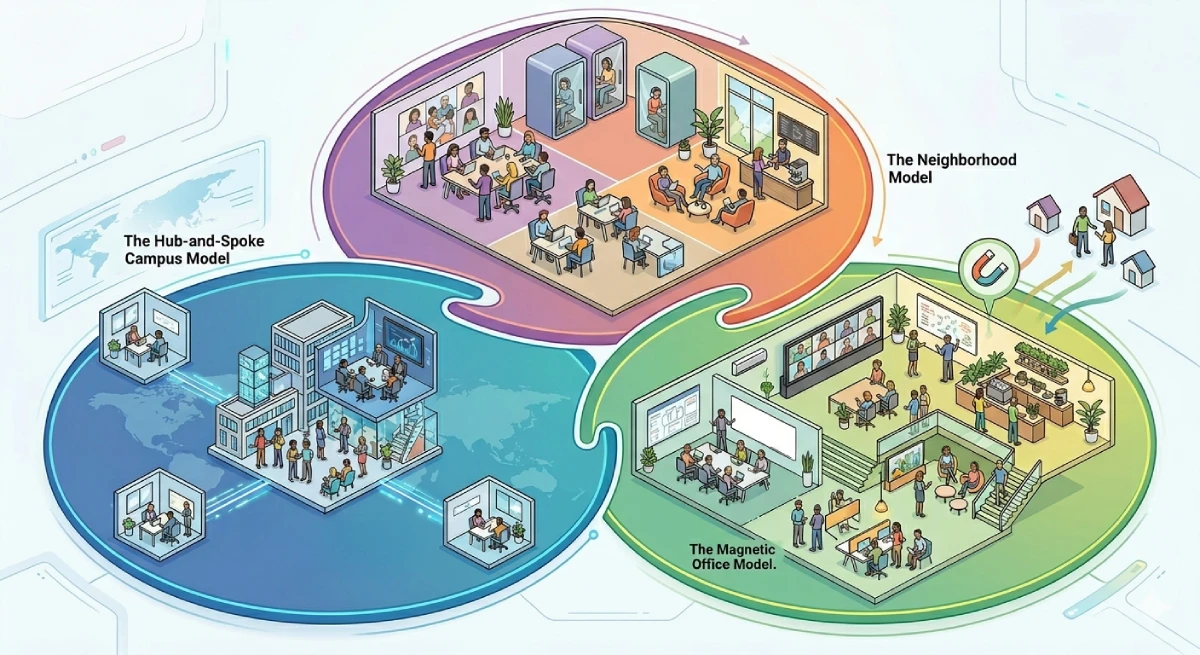
The neighborhood model organizes office space into dedicated "zones" aligned to work activities rather than departments or assigned desks. Instead of finance sitting together because they're finance, teams occupy zones designed for the types of work they need to do on any given day.
Typical zone structure:
| Zone | Purpose | Design Features |
|---|---|---|
| Collaborative Hub | Team meetings, workshops, ideation | Movable furniture, writable walls, AV-equipped |
| Focus Studio | Deep work, confidential calls | Acoustic pods, minimal visual distraction |
| Social/Café Area | Informal connection, casual collaboration | Lounge seating, natural light, hospitality feel |
| Flexible Workstations | Standard individual work | Bookable desks, standardized tech setup |
Microsoft's physical workspace strategy, as documented in their own research on hybrid work, is built on this model with real-time occupancy data informing how zones are adjusted over time.
Why it works for large companies: It accommodates fluctuating in-office headcount without creating empty or overcrowded areas. Spaces serve a function, not a headcount target.
Strategy 2: The Hub-and-Spoke Campus Model
Why Global Companies Use Flexible Hybrid Workplace Designs Across Locations
For organizations with multiple offices or a distributed global workforce, the hub-and-spoke model creates a hierarchy of workplace functions across locations.
- Hub offices (headquarters or regional centers): Full-service environments with all zone types, leadership presence, and high-production meeting infrastructure.
- Spoke offices (local or satellite spaces): Smaller, focused on collaboration and client interaction , not individual desk work, which remains remote.
Benefits for global enterprise firms:
- Reduces real estate cost by eliminating underutilized assigned desks
- Reinforces culture at hub level while offering local flexibility
- Supports cross-office collaboration when regional teams visit hubs
Companies like Deloitte and PwC have implemented hub-and-spoke models globally, using occupancy sensors and workplace analytics to continuously right-size their portfolios.
Top hybrid office layout strategies used in corporate offices at this scale often involve a 70/30 principle 70% of the floor plate is shared, flexible space; 30% is assigned or bookable for consistent presence.
Strategy 3: The Magnetic Office Model
Hybrid Office Layouts That Improve Collaboration and Productivity in Global Firms
The most sophisticated hybrid strategy isn't about space types it's about designing an experience compelling enough to draw people in voluntarily.
The magnetic office model is built on a simple premise when hybrid workers have a choice, they'll come to the office if and only if the office offers something meaningfully better than home. This model treats design as a retention and engagement tool.
Design elements that make an office "magnetic":
- Premium collaboration infrastructure :Large-format displays, seamless video conferencing, well-designed workshop rooms
- Hospitality-grade amenities: Quality coffee, natural materials, lighting that mirrors hospitality environments
- Social gravity points: Curated spaces where unplanned encounters happen naturally (open staircases, visible lounges, social kitchens)
- Acoustic quality: the ability to take a private call without leaving the floor
Firms that implement this model report higher voluntary office attendance, stronger cross-team relationships, and measurably better employee experience scores.
The Spatial Formula Behind Hybrid Productivity
Hybrid office layouts that improve collaboration and productivity aren't designed by intuition they follow a measurable spatial logic.
The most effective corporate hybrid offices balance three ratios:
- Collaborative-to-focus ratio: Typically 60% collaborative, 40% focus in knowledge-work environments
- Assigned-to-shared desk ratio: Ranges from 0:100 (fully unassigned) to 30:70 depending on role types present
- Meeting room-to-open space ratio: High-frequency meeting cultures need more enclosed rooms; project-based cultures need more open collaboration zones
Getting these ratios right requires understanding how your specific teams actually work not how you think they work. Space utilization studies, conducted before a redesign, are one of the most valuable investments a company can make before committing to a layout strategy.
Frequently Asked Questions
What is the most effective hybrid office layout strategy for large companies?
The neighborhood model organizing space into activity-based zones rather than department territories is most effective for large enterprises because it accommodates fluctuating headcount, supports different work modes, and creates clarity about where to go for each type of work.
Why do global companies invest in flexible hybrid workplace designs?
Flexible designs reduce wasted real estate by eliminating underutilized assigned desks, improve employee experience by giving workers choice, and allow the office to adapt as workforce size and schedules evolve without requiring physical renovation.
How do hybrid office layouts improve productivity?
They reduce friction. When the physical environment is aligned to the work being done a quiet pod for focus work, a collaborative zone for workshops, a social area for informal connection people spend less energy managing their environment and more energy on actual work.
What percentage of a hybrid office should be collaborative space?
In most knowledge-work environments, 60% collaborative and 40% focus space is the standard ratio. However, this should be validated against actual utilization data from the specific organization's work patterns.
What makes an office "magnetic" in a hybrid work model?
A magnetic office provides an experience that remote work cannot replicate high-quality collaboration infrastructure, hospitality-grade amenities, natural social gravity points, and acoustic comfort. The test is simple do employees choose to come in even when they don't have to?
Explore workplace strategy and design at AI Spaces